
Many parents worry about teaching elementary school children to read English because some children can pronounce words but don't understand what they're reading. Some remember vocabulary but get confused when putting words into sentences. Many families are unsure where to start: Sight Words? Phonics? Or should they just have their children read a lot?
In reality, reading skills aren't a one-step process, but rather like a ladder to climb step by step. It ranges from memorizing frequently used words and deciphering word patterns to reading fluently and understanding content analytically. This article invites everyone to explore each aspect and discuss how we can help children develop their English reading comprehension skills in a way that's not stressful for both children and adults, and that's practical for everyday life.
The Foundations of Reading: Sight Words and Phonics
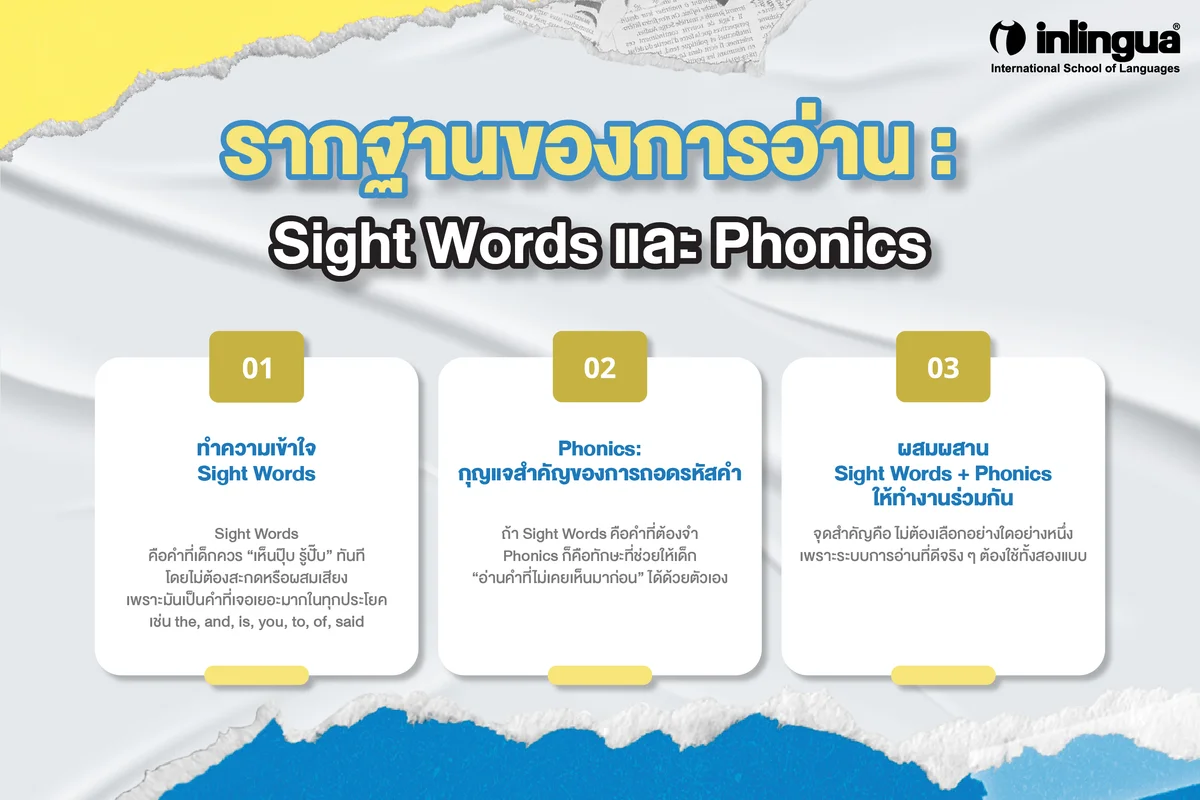
Before a child can read fluently, the first thing they need are two basic tools: Sight Words and Phonics These two things work differently, but they complement each other to help children read faster, understand easier, and without getting too tired. Let's look at each part in an easy-to-understand way.
1. Understanding Sight Words.
Sight words are words that children should be able to recognize immediately without having to spell or pronounce them, because they are words that appear frequently in every sentence, such as: the, and, is, you, to, of, said
Imagine if a child had to pronounce the word "the" every time they saw it... they would be exhausted from spelling and wouldn't have the energy left to understand the sentence. That's why Sight Words are a great brain-saving tool, allowing children to read more fluently and paving the way for better understanding without forcing themselves.
Why are sight words so important?
- Children read faster immediately because they don't have to spell basic words.
- Better understanding because the brain isn't strained by decoding.
- Boosting their confidence, children will feel, "Hey, I can read!"“
- Many words are not pronounced accurately and are difficult to decipher, for example: said, was
Fun and practical activities for teaching sight words.
- Flashcards for 5-10 minutes a day.
- Sight Word Bingo can be played as a family game.
- Find the words in the story you read (Word Hunt)
- Rainbow Writing: Write the same word in multiple colors. Kids love it!
2. Phonics: The key to decoding words.
If sight words are words that need to be memorized, phonics is the skill that helps children "read words they've never seen before" on their own.
Phonics is knowing "how each letter or group of sounds is pronounced," for example:
- a = /æ/
- sh = /ʃ/
- bl = /bl/
- igh = /aɪ/
Children with a strong foundation in phonics will be able to read almost any new word independently and will feel confident when encountering longer words because they know how to separate sounds and blend them together.
The basic phonics that should be taught.
- Sounds of single letters (a, b, c…)
- Consonant Blends (bl, st, str)
- Vowel Teams (ai, ee, ea, igh)
- Silent Letters (kn, wr, mb)
- R-controlled vowels (ar, er, ir, or, ur)
Techniques for teaching Phonics in a way that is easy to understand and remember.
- Segmenting: Separate the word into sounds, for example, dog → dog.
- Blending: Combine sounds to form words, for example, cat → cat.
- Word Families: Groups of words with similar ending sounds, such as -at (cat, hat, rat), are a fundamental basis for...Expand your English vocabulary. Quickly
- Decodable Readers: A book designed for practicing real sound mixing.
Children who understand phonics will feel that "reading isn't scary" because they have control over it.
3. Combine Sight Words and Phonics to make them work together.
The key point is You don't have to choose one or the other. Because a truly effective reading system requires both types.
- Sight Words Words to remember
- Phonics = Decoded words
- Context = Use sentences to help guess the meaning.
When used together, these three things will help children read faster, understand more, and get less tired—a truly noticeable result.
5 Steps to Improve Reading Comprehension
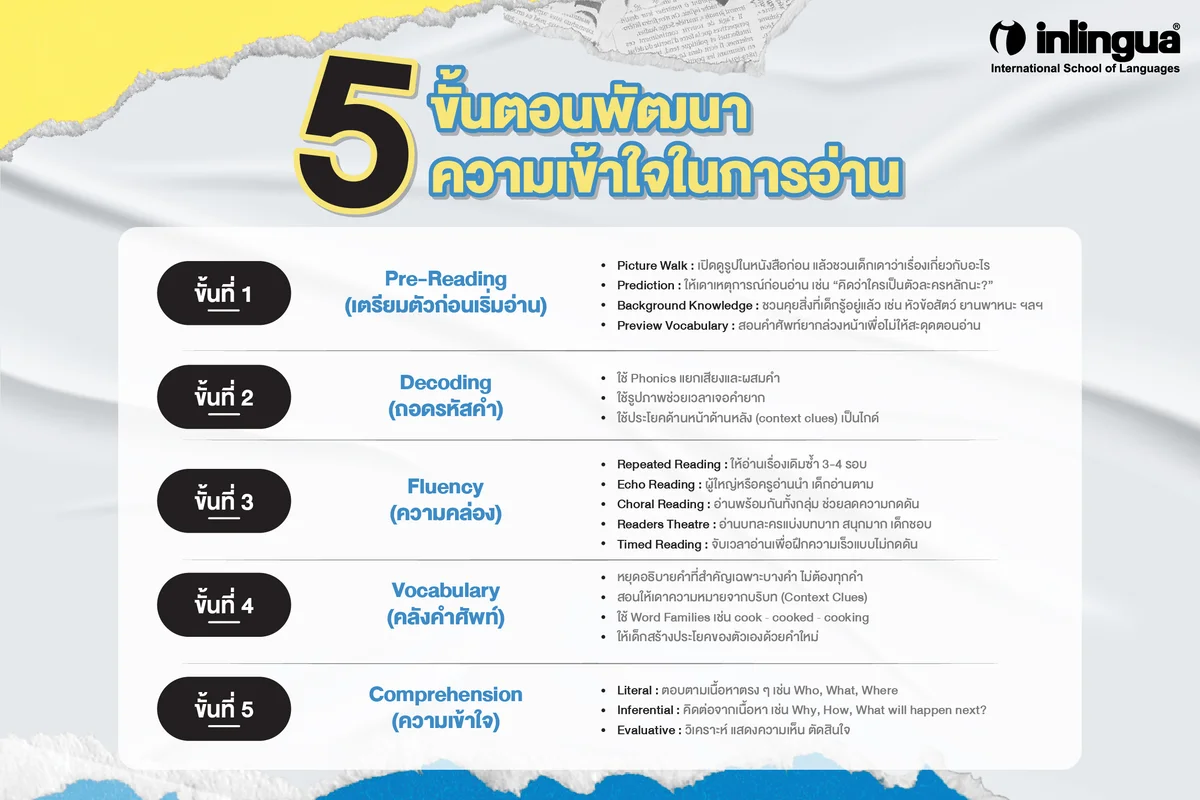
Once children have a foundation in sight words and phonics, the next step is to develop reading comprehension step-by-step. In reality, "reading" doesn't end with pronunciation, but is a multi-layered process that builds up like a ladder.
Step 1: Pre-Reading
Preparing before reading is like "warming up the body" to get the brain ready to receive information. Children will understand much more easily if they open the door to prior knowledge.
- Picture Walk: Look at the pictures in the book first, then ask the child to guess what the story is about.
- Prediction: Try guessing the plot before reading, for example, "Who do you think is the main character?"“
- Background Knowledge: Engage in conversations about things the child already knows, such as topics like animals, vehicles, etc.
- Preview Vocabulary: Teach difficult vocabulary in advance so you don't stumble while reading.
Step 2: Decoding (deciphering the words)
This is the stage where children use phonics + sight word memory to read words they encounter in sentences. They have to do two things simultaneously: “blend sounds” and “remember basic words.”
- Use phonics to separate sounds and blend words.
- Use pictures to help you when you encounter difficult words.
- Use context clues as a guide.
Step 3: Fluency
Reading fluency isn't just about reading quickly, but also about reading with rhythm, accuracy, and understanding. Children who read fluently have more "brain space" for comprehension than children who struggle to spell out each word.
- Repeated Reading: Read the same story 3-4 times.
- Echo Reading: An adult or teacher reads first, and the children read after.
- Choral Reading: Reading together as a group helps reduce stress.
- Readers Theatre: Reading the script and dividing the roles was so much fun. The kids loved it.
- Timed Reading: Time yourself while reading to practice your reading speed without pressure.
Step 4: Vocabulary
The more vocabulary a child has, the better their understanding will be, because they will be able to "interpret" the meaning of sentences in a more detailed way.
- Stop explaining only the important words, not every single one.
- Teaching how to guess meaning from context (Context Clues)
- Use word families, for example: cook → cooked → cooking.
- Have the children create their own sentences using new words.
Step 5: Comprehension
This is the ultimate goal: children must be able to “understand what they read,” not just read it aloud. Children should be able to answer questions at both basic and analytical levels, which aligns with... Critical Thinking Skills
- Literal: Answer directly based on the content, such as Who, What, Where.
- Inferential: Continue thinking based on the content, such as Why, How, What will happen next?
- Evaluative: Analyze, comment, and decide.
Post-reading comprehension check activity.
- Ask the 5W1H questions.
- Encourage children to retell the story in their own words.
- Draw a picture of the important scene.
- Create a story map to show the sequence of events.
Reading comprehension strategies
Once children can read and have a good foundation, what will truly make them "comprehensible" is their reading strategy, which we can easily divide into three main stages: Before reading – During reading – After reading
Before Reading Strategies
The period before reading is a light pre-reading session to prepare the brain and set goals before starting the story.
- KWL Chart:
- K (Know): The children already know something about this topic.
- W (Want to know): What else would you like to know?
- L (Learned): What new things did you learn after reading it?
- Making Predictions: Try guessing the possibilities before reading, such as, "What do you think this story is about?"“
- Setting Purpose: Set reading goals, such as "Read to find out why the character did what they did."“
During Reading Strategies
This is the heart of reading; children need to “think along” instead of just reading word for word.
- Visualization: Encourage children to imagine in their minds what might happen.
- Making Connections: Encourage children to connect with familiar things, such as Text-to-Self (Does it resemble their own life?), Text-to-Text (Does it resemble other books?), and Text-to-World (Does it resemble things in the real world?).
- Questioning: Encourage children to ask questions while reading, such as, "Why did the character do that?"“
- Monitoring Comprehension: Teach children to constantly check themselves, "Do I understand?" If not, have them stop and go back to reading it again.
After Reading Strategies
This phase helps to "lock in" understanding more firmly and enables children to analyze what they read better.
- Summarizing: Summarize the main points in a short sentence.
- Retelling: Retell the story in your own words, arranging the events in chronological order (beginning → problem → solution → ending).
- Reflecting: Encourage children to share their opinions, such as, "What did you like most?" or "If we were in the story, would we do something differently?"“
- Making Inferences: Read things that are "not explicitly written down," such as guessing how a character feels.
10 activities to improve reading comprehension.
Activities help children "hands-on use" rather than just reading through. Try these 10 activities that can be used both at home and in the classroom.
Activities for young children (Grades 1-2)
- Picture Sequencing – Arranging photos in chronological order: Show the child several pictures and have them arrange them in the order of the story read.
- Character Puppets – Storytelling character puppets: Make puppets from paper and have children tell stories using them. This is great for shy children because the characters will help them gain confidence in speaking and storytelling. This activity also helps develop... Speaking Confidence Very well.
- Story Dice – Children create stories by rolling dice: Write words or characters on dice, have the child roll them, and then tell a story based on the words that roll.
- Draw & Label – Draw a picture and write a description: After reading, have the child draw their favorite scene and write simple words to describe it.
- Question Cards – Answer the questions from the question cards: Adults write simple questions for children to choose from cards and answer.
Activities for older children (Grades 3-6)
- Story Mapping – A complete story diagram: Have the children break down the story into Beginning, Problem, Solution, and Ending sections.
- Character Analysis – Breaking down character traits: Have the children answer the questions about what the characters think and what kind of personalities they have.
- Compare & Contrast – Compare two things: Have children compare two characters or two events using a Venn diagram.
- Fact vs. Opinion: Teach children to distinguish between "factual information" and "personal opinions," a popular teaching activity. Critical Thinking Activities for Kids
- Cause & Effect – Finding the cause and effect: Ask the child to answer the question: what caused this event, and what is the result?
Assessment of reading comprehension
Reading skills improve only when we know "what level of understanding the child currently has" and "what areas still need improvement."“
An effective and non-pressuring assessment method for children.
- Running Records: The simplest way to keep a reading log is to have the child read aloud, and the adult notes down which words they mispronounced.
- Reading Inventories: Set of questions categorized by age level (Literal, Inferential, Evaluative)
- Comprehension Questions: Short comprehension questions (3-5 questions)
- Retelling Rubrics: Listening criteria for storytelling: Check if the events are narrated in the correct sequence and if all important details are included.
Progress tracking that can be done from home.
The evaluation doesn't have to be a big undertaking; a small, routine task will suffice. Parents can help keep track of their children. Simple methods include noting the names of the books read each week, creating a word count graph, keeping summaries of your writing, or listening to a child read once a month and recording it.
For parents interested in additional techniques on developing their children's reading skills, please refer to the following: Reading Rockets This is a leading source of information worldwide, or you can consult recommendations from... Scholastic Parents There are many activities that promote reading.
Solve common reading problems.

Regardless of their level, one thing they all have in common is that they will "have stumbles/falls." It's perfectly normal.
1. The child is a slow reader.
Slow reading in children doesn't necessarily mean they're not smart. It's mostly due to a lack of strong foundation in certain areas.
Solution: Review phonics, improve sight word recognition, practice repeated reading, and choose books that are “slightly easier.”
2. The child can read aloud, but doesn't understand.
She reads very well and pronounces words perfectly, but when asked what the story was about… she had no idea.
Solution: Pause to ask short questions during reading, teach visualization, have children retell the story in their own words, and use a story map to help grasp the plot.
3. The child is not interested in reading.
This is more about motivation than skill.
Solution: Choose books that match their interests, read them aloud often, change the reading environment, and use picture books or comic books.
English reading comprehension can be improved.
Reading comprehension is not a gift for some children, but it is... Skills that can be developed Like cycling or swimming, every child can improve if they have the right tools, a positive environment, and consistent practice.
The important thing is to take your time and avoid putting pressure on yourself. Gradually build a foundation through Sight Words and Phonics, then progress to fluent reading. Vocabulary expansion And various reading strategies that help children truly "think along" with what they read.
And the better a child can read and understand, the more other skills will develop, such as: Writing Speaking skills, analytical thinking, learning other subjects (especially science and math), and confidence in using English in daily life are all important.
If parents want to systematically and enjoyably enhance their children's reading skills, they can find more details here. English language courses for elementary school children. Our goal is to help our children develop a love of reading and build a strong foundation.