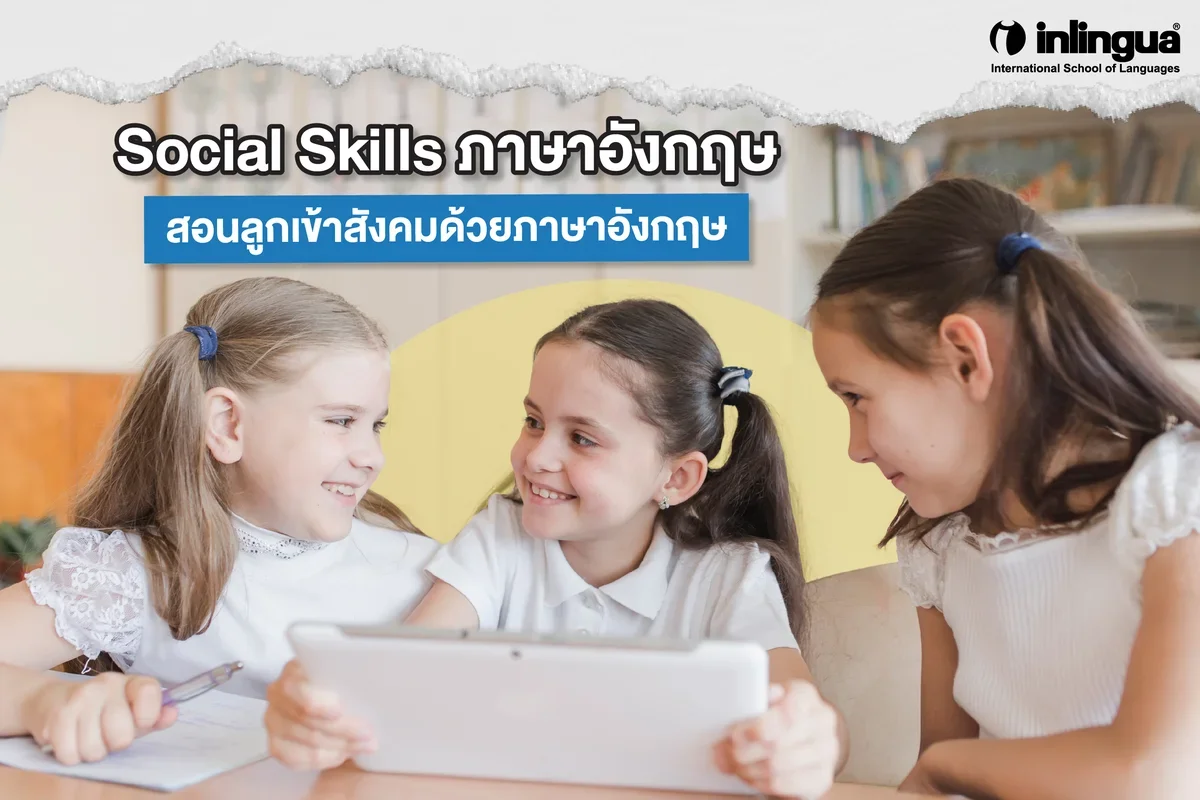
When we think of "English for elementary school children," we usually think of vocabulary, grammar, or homework, right? But in reality, English is also a crucial gateway that helps children socialize, forge new friendships, and learn to get along better with others.
Children who can communicate, knowing phrases for greetings, asking to join a group, or expressing feelings, will adapt to the classroom much more easily, both with Thai and foreign classmates. It also significantly boosts their confidence.
This article aims to encourage parents and teachers to focus on "English for Friendship" in an easy-to-understand way, with practical phrases and social skill-building activities that children can use immediately in their daily lives.

Why are social skills important?
When we talk about social skills, many people often think of them as skills that children will gradually learn naturally as they grow. But the truth is, these skills... Must practice Just like reading, writing, or math, children with strong social skills have a smoother school life, make friends more easily, and manage their emotions much better.
Let's look at the key reasons, in simple terms, why social skills are so important for elementary school children.
1. Relationship to future success.
Numerous studies consistently show that children with good social skills grow up to be adults who:
- Works well with others.
- Confident in expressing oneself.
- Good at solving problems on the spot.
- Able to adapt quickly to new situations.
- There is a higher chance of success in both academic and professional life.
It's not just about having many friends, but it's about having "life skills" that can take you far.
2. Language is a bridge to social interaction.
Many children may know a lot of basic English vocabulary, but they don't yet know "how to use the language" to interact with others. This is where English for Friendship can be very helpful, for example:
- How do I start the conversation?
- How do I invite my friends to play?
- How to politely accept or decline a request.
- How to express gratitude, apologize, or ask for help.
When children have "ready-made phrases" in their vocabulary, they feel noticeably more confident and courageous in communicating, which aligns with their development. Basic English for Elementary School Children Focusing on practical application in all situations.
3. Practice seeing the world from other people's perspectives (Empathy).
Social skills aren't just about being talkative, but about the ability to:
- I understand how my friend feels.
- Knowing how to say something to make the other person feel.
- Guessing emotions from tone of voice or facial expressions.
- Help comfort or encourage a friend.
These things help children build good relationships and become lovely friends with everyone in the classroom.
4. Use language to manage emotions and conflict.
Children with social skills know how to communicate when they have problems, for example, instead of snatching toys, they say: “Can we take turns?” Or, instead of making a fuss, they might say: “I don't like it when you do that.” It reduces arguments and significantly improves the classroom atmosphere.
Basic skills: Greetings and introductions.
Before they can build friendships, solve problems, or work as a team, children need to start with the most basic skill: "initiating a conversation." This is where many children get stuck because they don't know how to start. But if they have practical phrases they can use, they will feel much more confident.
Greetings
Greeting is the first step in any relationship. Children who know how to greet people are more likely to initiate conversations with their friends sooner.
- Greeting phrases: Hi!, Hello!, Good morning!, Good afternoon!, Good evening!, Hey! (Used with close friends)
- How should I answer?: Hi!, Hello!, Good morning!, I'm good, and you?, Nice to see you!
- Example situation: Greet your teacher: “Good morning, Teacher!”, Greet your friend: “Hi, Ben! How are you?”
Introducing Yourself
Introducing oneself is the next step in socializing, encouraging children to confidently state their name, express their likes, and initiate conversations in English. This activity also helps practice... Speaking Confidence Through training in various ways of introducing oneself.
A simple structure that children can use in any situation:
- greet: Hi!
- State your name: My name is… / You can call me…
- Tell me your age: I'm 9 years old. (If required)
- Things I like: I like…
- Question in return: What about you?
Activity: Meet & Greet Circle
How to play:
- The children are standing in a circle.
- Random matching.
- They walked towards each other in the middle of the circle.
- Greet + Introduce yourself + Ask one question.
- Change to a new partner.
This game helps children practice saying something repeatedly until it becomes second nature and significantly reduces their shyness.
Building and maintaining friendships.
Once children can greet and introduce themselves, the next step is to "build friendships," a very important skill during elementary school. Children who are good at socializing tend to be happier at school.
Inviting friends to play.
These are sentences that will help children feel comfortable asking to participate or inviting others to join in the fun.
- A simple sentence to invite a game: Do you want to play with me?, Would you like to join us?, Can I play too?
- Response: Yes, sure!, That sounds fun!, I'd love to!
- Polite refusal: I'm sorry, I can't right now., Maybe later?
Sharing and Taking Turns
These are very important skills for elementary school children. Sharing makes children well-liked by their friends, while waiting in line helps them play smoothly with others.
- Practical sentences: Can I have a turn?, You can go first., Let's take turns., Here, you can use this.
Encouraging a friend.
Children who encourage their friends will be the kind of friends that everyone wants to be around.
- Words of encouragement: You can do it!, Don't give up!, Great job!
- When a friend makes a mistake: It's okay. Everyone makes mistakes., Try again. You're getting better!
Politeness and Respect
Social skills are incomplete if children don't understand "manners" and "respect," which are fundamental to living with others. The English language itself has many ways of speaking that show politeness.
Saying Thank You and Responding to It
- Basic expressions of gratitude: Thank you., Thanks!, Thank you so much!
- Response when someone thanks you: You're welcome., No problem., Anytime!
Saying Sorry
- Simple sentences: I'm sorry., I'm really sorry., Oops, sorry!, Excuse me.
- Response when someone apologizes: It's okay., Don't worry about it., It's fine.
Asking for Permission
Children who know how to say "ask for permission" automatically appear polite and disciplined.
- Polite phrases: May I…?, Can I…?, Could I…?
- example: May I borrow your pencil?, May I go to the bathroom?
For parents who want to learn more techniques for teaching manners and social skills to their children, you can find helpful information here. Positive Psychology – Social Skills Training for Kids It contains a wide variety of interesting activities and exercises.
Conflict Resolution
Every child encounters conflict situations. Teaching children to "manage problems mindfully" through English is an important skill that helps them function well in society. This problem-solving skill is related to... Critical Thinking Skill It helps children analyze situations and find logical solutions.
Expressing Feelings Through Words
Teach children to use structures. “"I-Statements"” To express feelings without blaming a friend.
- I feel sad when you take my toy because I was playing with it.
- I feel upset when you shout at me because it hurts my feelings.
Asking someone to stop politely.
- Please stop.
- I don't like that.
- Please don't do that again.
Finding solutions together (Compromise & Solutions)
- How about we take turns?
- Let's try it this way.
- What if we play both games?
When should you ask for help?
Children need to understand that they don't always have to handle things alone, especially when situations become dangerous.
- Teacher, I need help.
- Can you help us? We have a problem.
- I feel scared.
Teamwork Skills
Teamwork skills are one of the most important social skills. Children who can work with their peers, divide tasks, and communicate politely will have an advantage in the classroom.
Basic skills of collaboration.
- Suggest an idea: I have an idea., What if we try this?
- Ask your friends for their opinions: What do you think?, Do you agree?
- Support a friend: That's a great idea!, Good thinking!
Giving and receiving constructive feedback.
- How to give good feedback: Start with something good.I like how you…) followed by polite advice.Maybe we could try…) and give encouragement.You're doing great!)
- Receiving Feedback: Thank you., I'll try that.
Practical team building activities.
- Tower Building Challenge: Using paper cups or blocks, have your team build the tallest tower possible.
- Group Story Creation: Write a story together, one sentence each. This activity helps develop writing skills. Creative Writing They perform well in group settings.
- Scavenger Hunt: Give the children a list of items they need to find within a time limit, working in teams.
Learning through role-playing.
Role-playing is one of the most effective ways to teach social skills because children get to “try things out” in a safe, simulated environment.
- Scenario 1: Joining a new group of friends: Practice greeting people and asking to join a game.
- Scenario 2: Someone is bullying you, or a friend is saying something mean to you: Practice setting boundaries with confidence.
- Scenario 3: Invite friends over: Practice good hosting etiquette.
Support from parents and teachers.
Teaching social skills is not solely the responsibility of children. Children learn much better when parents and teachers work together to create a safe environment. Parents can apply techniques from... Help my child with their English homework. It can also be used to practice social skills at home.
Being a good role model (Modeling)
Children learn from what adults do, such as greeting others first, saying thank you and apologizing sincerely, or waiting for others to finish speaking before responding.
Appreciation and encouragement (Positive Reinforcement)
When a child demonstrates good social skills, praise them immediately. For example, "I saw you sharing your toy with your friend just now. That's great!"“
Creating opportunities for children to practice (Practice Opportunities)
- at home: Play board games, cook with parents, invite friends over.
- In the classroom: Group projects, Show & Tell, Buddy System
For teachers and parents looking for additional resources on social skills development activities, please see: PBS Kids for Parents – Social Skills It includes articles and activities designed specifically to strengthen positive relationships among children.
Social skills through the English language can be taught and practiced.
Finally, I want parents and teachers to have a clear picture that... Social skills are not a gift. Children are not born with courage, gentleness, or the ability to approach friends. These are all "skills that can be taught and must be practiced repeatedly," just like reading, writing, or memorizing vocabulary.
The same applies to English. Children will be able to use the language more fluently in social situations when they have the right support from those around them. If parents want to naturally enhance their children's language and social skills, they can find more details here. English language courses for elementary school children. That's what we aim for, so that our children can grow up confident and happy in their learning.