Why track progress?
Have you ever felt like you've been studying English for a long time, but you're not sure if you've "really improved"? Have you spoken more? Do you understand more? Or are you really stuck in the same place because you've never systematically measured your progress? Many people are extremely diligent in their studies, but eventually lose their motivation because they don't see clear results, when in reality... they've improved more than they thought. They just "didn't measure it," so they don't know.
The problem of not tracking progress
- ❌ Don't know where you are
- ❌ No results, causing loss of motivation
- ❌ Unable to adjust learning methods in time if the old method is ineffective
- ❌ Waste both time and money without knowing whether it's worth it or not.
But if you have a good tracking system… everything can change instantly.
- ✅ See real progress – have the motivation to continue studying
- ✅ Know your weaknesses – adjust them accordingly
- ✅ Adjust your learning method to suit your level – save time
- ✅ Know that our efforts are “paying off”
💡 Tips: Don't wait for someone to tell you, "You're getting better." If you have your own tracking system, you'll know every week that you're making progress. Read more: Learn English one-on-one for the best value.
1. Progress measurement tools
If you want to know if you've "gotten better," you need a clear measurement tool. It's not just a feeling that you "might be better," but you need real data to confirm it. Good tracking is a combination of: Formal measurement (Progress Test) with Self-Assessment Including recording everything in Learning Log
1. Progress Tests – Periodic level testing
Testing provides a clear picture of progress, whether you are studying on your own or with an institution. A “measurement period” should be held every three months. Suitable frequency:
- ✅ Every 3-4 months → Suitable, see real development results
- ❌ Every week → Too often, results don't change much.
- ❌ Every year → Too long, unable to adjust plans in time
Types of testing

1. Official Tests (International Standards) It can be used to measure levels worldwide. It is suitable for people who have further goals, such as applying for a job or continuing their studies.
| Test name | Score/Level | Suitable for |
| CEFR Placement Test | A1-C2 | Measure overall language level |
| IELTS | 0-9 | Use for further study/work abroad |
| TOEIC | 10-990 | Used in general organizations |
| TOEFL iBT | 0-120 | Use to apply for further studies |
2. Online Tests (Free and Convenient) Suitable for a quick check by yourself.
- Cambridge English Test – It takes 15 minutes.
- EF SET – Free, get a certificate
- British Council Level Test – It takes 25 minutes.
inlingua Progress Test

At inlingua, we offer both pre-course tests and post-course tests every 10 weeks or upon completion of the course.
| skills | Evaluation format | period |
| Speaking | Live interview | 10 minutes |
| Listening | Multiple choice test | 20 minutes |
| Grammar | Grammar of tenses and vocabulary | 30 minutes |
The results you will get:
- Comparison of scores with previous rounds
- Strengths and weaknesses analysis that need to be developed
- Personalized learning advice
- Study strategies for the next course
How to easily read the results

| change | meaning | What should I do? |
| Add 10%+ | Great development! | Continue the original plan |
| Add 5-10% | very good | Some skills training may be added. |
| Add 0-5% | slow | Adjust your study method or increase your time. |
| No change / Decrease | have a problem | Adjust plans immediately |
💡 Tips: Don't be afraid of the test results because the test is a "guidance", not a "judgment". It helps you know which way to go, not that you are not good enough.
2. Learning Log & Journal (Learning Log)
If you want to know how much you've improved without relying solely on tests, keeping a journal is the easiest and most powerful way. It allows you to clearly see your day-to-day and week-to-week changes.
Why do I need to record my studies?
- ✅ See your own development in a tangible way
- ✅ Know what you have learned and don't forget anything.
- ✅ Identify weaknesses repeatedly to address them at the right point.
- ✅ Create motivation because progress is more visible.
💡 Tips: Don't be afraid of the blank page, as it can greatly improve your self-improvement. Just write a few lines a day. The key is consistency, not length.“
Recommended recording formats
After each lesson (takes 5 minutes)
Date: Oct 22, 2025 Topic: Business Email Writing Duration: 90 minutes What I learned:
- Using polite language in emails
- Formal email structure
- New words: attached, regarding, sincerely
Mistakes corrected:
- “I am writing” → “I am writing”
- “Please to help” → “Please help”
Next step:
- Write a new email based on the teacher's feedback.
- Review 15 vocabulary words
Feeling: Gain more understanding and confidence when writing.
Weekly (10-15 minutes)
Week: Oct 14-20, 2025
Achievements: ✓ Complete 3 lessons ✓ Write a journal for 5 days ✓ Listen to podcasts for 3 hours ✓ Learn 80 vocabulary words
Challenges: ✗ Still stuttering when explaining reasons ✗ Still can't pronounce "th" clearly
Next week's goals: → Practice pronunciation for 10 minutes/day → Practice explaining your opinion in English for 1 topic per day.
💡 Tips: Writing in bullet points is easier and faster than writing long sentences.
Monthly (20-30 minutes)
Month: October 2025 Overall progress:
- Level: From A2 → B1
- Listen and understand more 70%
- Start speaking without translating in your head.
Milestones:
- First time talking to foreign customers
- Write your own business emails without any help from anyone.
- Complete 12 lessons
Areas to improve:
- Writing still uses some incorrect grammar.
- There is still little business vocabulary.
Next month's focus: → Increase journal writing → Memorize 10 technical terms per day.
Digital tools to help manage Learning Logs

| App | Highlights |
| Notion | Create tables, insert images, videos, checklists, all complete. |
| Google Docs | Easy to use, accessible on all devices |
| Evernote | Save notes with audio and attachments |
| Day One | For those who want to write a beautiful journal like a diary. |
💡 Tips: If you're too lazy to write, you can use the "audio recording" method to summarize what you've learned instead. The important thing is to keep track of your learning to see your progress each month.
3. Self-Assessment Checklist
Sometimes you don't need to take a test or have someone measure you, because "you" are the best measuring tool. Just know how to observe and ask the right questions.
Why is self-evaluation important?
- Helps you know what areas you are developing in
- See what is lacking and adjust plans quickly
- It's a small motivation to keep studying.
- Easy to do, no special equipment required.
💡 Tips: Don't think that self-evaluation has to be as precise as an exam. Look at it as a "self-reflection" to see if you've really improved.
Monthly Checklist Example
Speaking
| question | ✔ / ✖ |
| Do I speak more fluently (stop thinking less)? | |
| Do I use a wider range of vocabulary? | |
| Have I pronounced it more clearly? | |
| Do I dare to speak to foreigners? | |
| Can I speak on new topics? |
Listening
| question | ✔ / ✖ |
| Do I understand the content better? | |
| Do I need to listen to it less often? | |
| Can I grasp the main idea faster? | |
| Do I understand different accents better? |
Reading
| question | ✔ / ✖ |
| Do I read faster? | |
| Can I understand without translating every word? | |
| Can I read more difficult content? | |
| Can I guess the meaning from the context? |
Writing
| question | ✔ / ✖ |
| Can I write faster? | |
| Are there fewer grammar mistakes? | |
| Use more complex sentence structures? | |
| Is it written more clearly and easily understood? |
Give yourself a simple score
| score | meaning |
| 1 | Worse than before |
| 2 | No change |
| 3 | Slightly better |
| 4 | Clearly improved |
| 5 | Greatly improved |
💡 Tips: If the average score is less than 3 = you need to adjust your plan. If you get 3 or more = you are on the right track.
Increase accuracy by using the CEFR Framework

Use the CEFR reference table (A1-C2) to compare with your current level, such as:
| Level | Overall appearance |
| A1-A2 | Can only talk about simple things |
| B1-B2 | Able to converse and understand general topics |
| C1-C2 | Use language naturally at a high level |
💡 Final tip: Keep a record of your scores and checklist for each month to look back on. If you see that from the first month you were “unable to speak” → the third month you were “able to speak continuously”, you will immediately know how much you have improved.
4. Recording & Playback (Record and Playback)
This is one of the most “visible” ways to improve your voice, because your voice in the first month will definitely be different from your voice in the third month. Many people are hesitant to record themselves because they “don’t want to hear themselves.” But believe me, if you really want to improve your speaking skills, recording your voice is your best friend.
Why do you have to record audio?
- I saw clear development (accent, fluency, confidence)
- Hear the points that need to be corrected, such as the r, th sounds, or word emphasis.
- The brain learns faster when it “sees and hears” itself speak.
- It is evidence of language growth, like taking a photo to look back on when you are good at it.
💡 Tips: You don't have to record every day, just once a month is enough, but you must use the "same topic" each time to be able to compare actual progress.
How to do a simple recording practice
- Choose the same topic every month For example, “Introduce yourself” or “My favorite hobby.”
- Record yourself speaking for 2-3 minutes. You can use your phone without any special equipment.
- Save the file name with date. For example, “Speaking_Practice_Oct2025.mp3”
- Listen again compared to the previous month Then note how it has changed.
Things to note when comparing sounds
| side | Notice what has changed |
| Fluency | Can you speak longer? Do you pause to think less? |
| Pronunciation | Is it clearer? Has the sound you used to make mistakes improved? |
| Accuracy | Is the grammar correct? |
| Vocabulary | Use more diverse words? |
| Confidence | Does your voice sound more confident? Is it powerful? |
Example of monthly development
| month | Speaking style | Change |
| Month 1 | Speak slowly, pause often, and think in Thai before translating. | start |
| February | Speak more continuously, use more new vocabulary. | better |
| March | Think in English and use idioms and phrasal verbs. | Developed a lot |
Recommended tools

| App | Highlights |
| Voice Recorder (Mobile) | Easiest to use, save instantly |
| Otter.ai | Automatically convert speech to text |
| Rev Voice Recorder | Clear sound, suitable for storing long files |
💡 Tips: When you finish recording, name the file with the date and title so you can see the progress in a timeline, like “Intro_Jan25.mp3” → “Intro_Apr25.mp3.” Then listen to the comparison, you'll be smiling.
5. Feedback from teachers and friends
Sometimes we don't see our mistakes because we're too used to them. This is where feedback from others can help open our eyes to things we overlook. Whether it's teachers, study partners, or international friends, they can all help us improve.
Why is Feedback Important?
- Know where you “went wrong” without guessing.
- Immediately adjust your speaking, writing, or use of words.
- Understand the listener's perspective, especially native speakers.
- Increase confidence because you know you are developing in the right direction.
💡 Tips: Don't be afraid of the word "wrong." Being corrected is a sign that you are learning.
Feedback from the teacher: Very accurate and detailed.
Teachers will notice flaws that we are not aware of, such as using the wrong tense or unclear pronunciation. After every lesson, you should ask your teacher something like this: “What can I improve from today's class?” “Which mistakes should I focus on fixing first?” Things teachers often give feedback on:
- Grammar that is repeatedly used incorrectly
- Pronunciation of some words
- Arranging sentences to sound natural
- Vocabulary appropriate to real context
Sample Feedback Report from inlingua
| skills | Before studying | After class | Change | advice |
| Speaking | A2 | B1 | ⭐⭐⭐⭐ | Practice your pronunciation more. |
| Listening | A2 | A2+ | ⭐⭐⭐ | Listen to faster content |
| Reading | B1 | B1+ | ⭐⭐⭐⭐ | Read a longer article |
| Writing | A2 | A2+ | ⭐⭐ | Practice writing complex sentences |
Summary of recommendations:
- Practice adding th, r sounds.
- Write two business emails per week.
- Listen to podcasts that speak faster 10-20%
💡 Tips: Teachers should keep a “Progress Report” every 10 lessons to see clear progress.
Feedback from friends or foreigners (Language Partner)
Even though it was informal, it was very helpful because we got to practice in a “real-world” situation.” How to politely ask for feedback: “Hey, I'm practicing my English. Can you tell me if I sound natural?” “Was my pronunciation clear?” “Any suggestions to improve?” Recommended apps:
- HelloTalk – Chat and call with native speakers
- Tandem – Language exchange (speaking/writing)
- ConversationExchange – Make an appointment to chat online
- Discord English Servers – Free access to the English chat room
💡 Tips: Don't ask him to "teach" you, but ask him to "tell you his true feelings" because listening to feedback from the listener's perspective will help you adjust your voice and tone more naturally. Brief summary:
- Teacher = Accuracy
- Friends = Nature
- Together = can develop both “correctness” and “true fluency”
2. When progress slows down (Plateau Phase)
Have you ever… suddenly felt like “no matter how much I study, I don’t get any better?” The way you speak is the same, the way you listen makes the same mistakes, even though you try your best every day? If you feel this way, it means you are in “Plateau Phase”During the slow development period, it seems like it is standing still, even though in reality the brain is “organizing knowledge”.
What is Plateau Phase?
It's a time when your development seems to stop even though you're still learning. It's similar to when you exercise and your weight doesn't decrease even though you're doing the same thing over and over again. Signs that indicate you are in Plateau Phase:
- Studying a lot but feeling no progress
- Listening or speaking doesn't make it any better than before.
- Bored, no motivation
- I started to wonder, “Are we going the wrong way?”
💡 Remember: Plateau is a “resting period for the brain” before taking a new leap.
Common causes + solutions
1. Staying in your comfort zone for too long
- Study the same content
- Listen only to media that is easy to understand.
- Always use the same vocabulary
exit:
- ✅ Try learning new topics such as business, travel, science.
- ✅ Watch slightly more difficult media (about 80%)
- ✅ Practice speaking on topics you are not good at, such as debates or presentations.
💡 Tips: Don't choose a medium that is difficult and discouraging. Just choose one that is "a little bit more difficult than the current level."
2. Lack of diversity
- Listen to the same podcast only
- Read only the news
- Talk to the same people
exit:
- ✅ Change the media genre every week, for example → this week podcast → next week YouTube → next week series.
- ✅ Listen to new accents (British, American, Australian)
- ✅ Find new friends to chat with in language exchange apps
3. Studying too passively
- Just listen without practicing speaking.
- Read only without writing
- Watch series but don't review vocabulary
exit:
- ✅ Change to Active Learning such as → Shadowing while watching a clip → Writing a summary after listening to a podcast → Speaking along to the sentences in the movie.
- ✅ Apply what you learn in real life, such as writing English captions on social media.
💡 Tips: Every time you come across a new word, try using it within 24 hours. Your brain will remember it more permanently.
4. Not reviewed regularly
- I studied and forgot because I never looked back.
- There is no clear review system.
exit:
- ✅ Use the app like Anki or Quizlet For Spaced Repetition
- ✅ Review old content before studying new content.
- ✅ Organize a “review day” every week, such as every Sunday.
How to overcome the Plateau and grow again
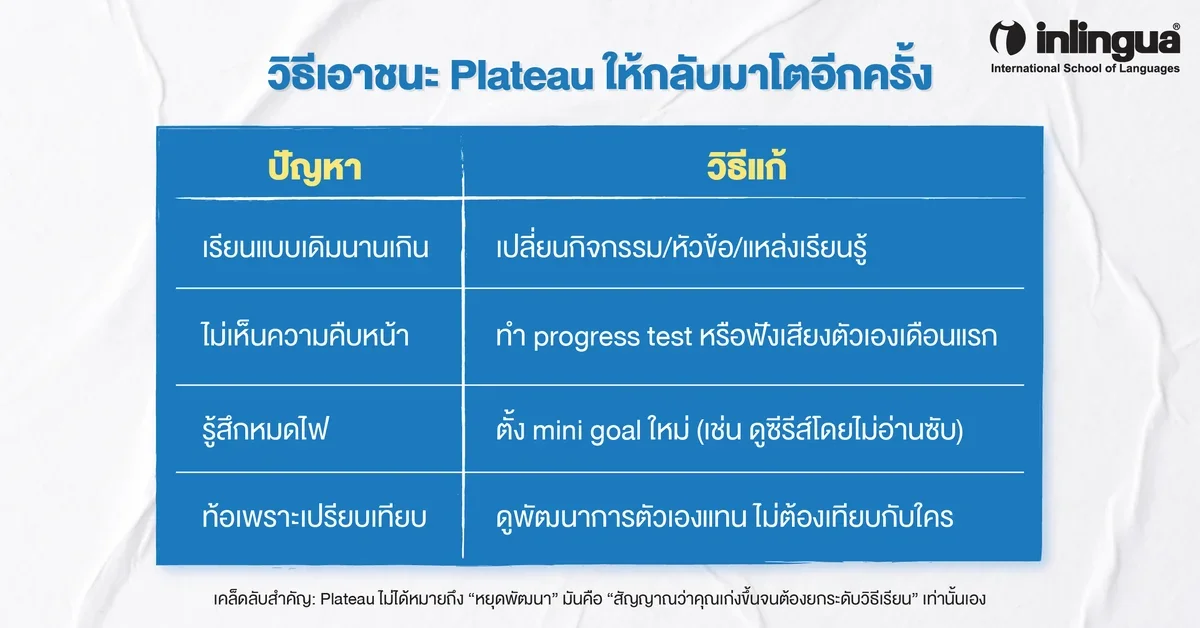
| problem | Solution |
| Studying the same way for too long | Change activities/topic/learning resources |
| No progress seen | Do a progress test or listen to yourself in the first month. |
| Feeling burned out | Set a new mini goal (e.g., watch a series without reading subtitles) |
| Discouraged by comparison | Look at your own development instead, don't compare yourself to others. |
💡 Important tips: Plateau doesn't mean "stop improving." It's simply a "signal that you've improved enough to need to upgrade your learning style." Remember: Everyone has to go through this, no matter how good they are. The important thing is Don't stop learning, just change the way you study. Read more: Adjust your English learning method to suit your own style.
3. Continuous improvement techniques
Once you know how much you've improved, the next thing to do is "adjust and move forward," because learning a language doesn't end when you can speak it. It's a process that requires continuous development.
1. Reflect & Adjust (Reflect and adjust the plan)
Every 2-4 weeks, take a moment to ask yourself…
- Can I follow the plan?
- What feels like work and what doesn't?
- Should I change anything to improve my learning?
💡 Tips: Don't be afraid to change your plans. Sometimes the best learning begins with "trial and error."“
2. Celebrate Small Wins
You don't have to wait until you're as fluent as a native speaker to feel proud. Learning English is a "long journey" that should be celebrated every little step you take. A few ideas to help you feel encouraged:
- Complete 10 lessons → Watch your favorite movie without subtitles.
- Remember 500 words → Buy yourself a gift
- Speak without stuttering for 5 minutes → Write a journal to praise yourself.
💡 Tips: Every time you celebrate a success, your brain “remembers the good feeling,” making you want to come back and repeat the lesson without forcing yourself.
3. Stay Motivated
Some days you may feel discouraged or bored, that's normal for everyone. The important thing is Don't stop for too long Because the longer you stop, the harder it is to start again. Simple ways to stay motivated:
- Listen to yourself from the first month → You will see the change.
- Write your goals on the table, such as “Be able to speak with foreign customers.”
- Watch clips of people who have successfully completed their studies → Recharge your batteries
- Talk to your teacher or classmates → Get some motivation back.
Sentences to remember: “You can get tired, but don’t stop for too long.”
4. Be Patient (Be patient and consistent)
Learning a language is like running a marathon, not a 100-meter race. Don't expect results in a week, as it takes time to move from one level (eg A2 → B1) on average. 6-12 months Things to remember:
- Consistency is more important than speed
- Every time you practice, you increase your “language accumulation”.”
- Some days you may not feel like you're making progress, but your brain is quietly learning.
💡 Growth Mindset Reminder: “I’m not good yet… but I’m getting better every day.”
Efficient tracking system
Finally, if you want to see clear and continuous progress, the key isn't "studying a lot," but rather "learning systematically and measurably." Tracking your progress is a mirror reflecting where you are, where you're headed, and where you need to improve.
5 Key Tools for Measuring Progress
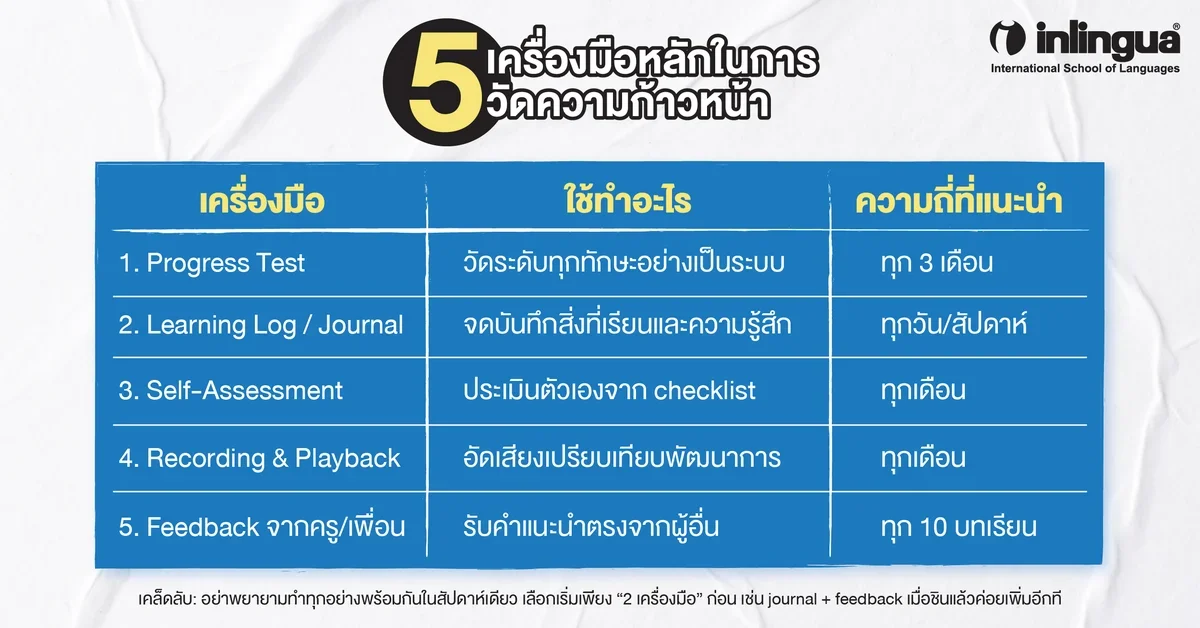
| tool | What is it used for? | Recommended frequency |
| 1. Progress Test | Systematically measure all skills | Every 3 months |
| 2. Learning Log / Journal | Keep a record of what you learn and your feelings. | Every day/week |
| 3. Self-Assessment | Evaluate yourself from the checklist | Every month |
| 4. Recording & Playback | Recorded audio comparing development | Every month |
| 5. Feedback from teachers/peers | Get direct advice from others | Every 10 lessons |
💡 Tips: Don't try to do everything at once in one week. Start with just two tools, such as a journal and feedback, and then add more as you get used to them.
The formula for success for people who can truly develop
- ✅ Consistent Practice – Practice regularly
- ✅ Regular Tracking – Check progress periodically.
- ✅ Timely Adjustment – Adjust your plan quickly when it starts to slow down.
Together = Steady Progress 🚀
🎯 Let inlingua help you track your progress.
Not sure where to start tracking? inlingua It is designed to help you see tangible progress. inlingua Tracking System:
- Progress Test CEFR Standard All courses
- Monthly Progress Report Course Summary
- Academic Advisor Support That helps analyze strengths and weaknesses
- Personalized Learning Plan Individualized learning plans
💡 Tips from real learners: Students who “measure regularly” often reach their goals twice as fast because they know what works and what doesn’t – and can adjust quickly. Ready to start measuring and seeing your growth? Because every step you take is another step closer to “true agility.”
CONTACT
- Line: @inlinguathailand
- Email: [email protected]
- website: https://www.inlinguabangkok.com/
Stop byBranch near you To plan your initial session with an expert teacher or make a reservation Free Consultation To create a personal Self-Study plan with an inlingua advisor. Read more: Learn English on your own: Effective strategies