Weaknesses are what you need to focus on.
Have you ever studied English for a long time but still felt stuck in some areas? You can speak a little but your pronunciation isn't clear, you can write but your grammar is always incorrect, or you might feel dizzy just hearing a native speaker speak a little too quickly. Actually, this problem isn't caused by a lack of "ability," but rather by "studying everything equally." Instead of focusing on areas of weakness, we spend time rehashing what we already know. The result is...
-
- I study a lot but I don't feel any improvement.
- Waste of time without real results
- Feeling burned out because I don't see any progress
💡 A better approach: Spend 70% on your “weaknesses” and another 30% on your “strengths.” When you focus only on what needs to be adjusted, your brain learns much faster. In this article, we'll take a look at:
- How do we know what our weaknesses are?
- Specific solutions for each skill
- And how to create a training plan that actually produces improvement in just a few weeks.
Read more: Learn English one-on-one for the best value.
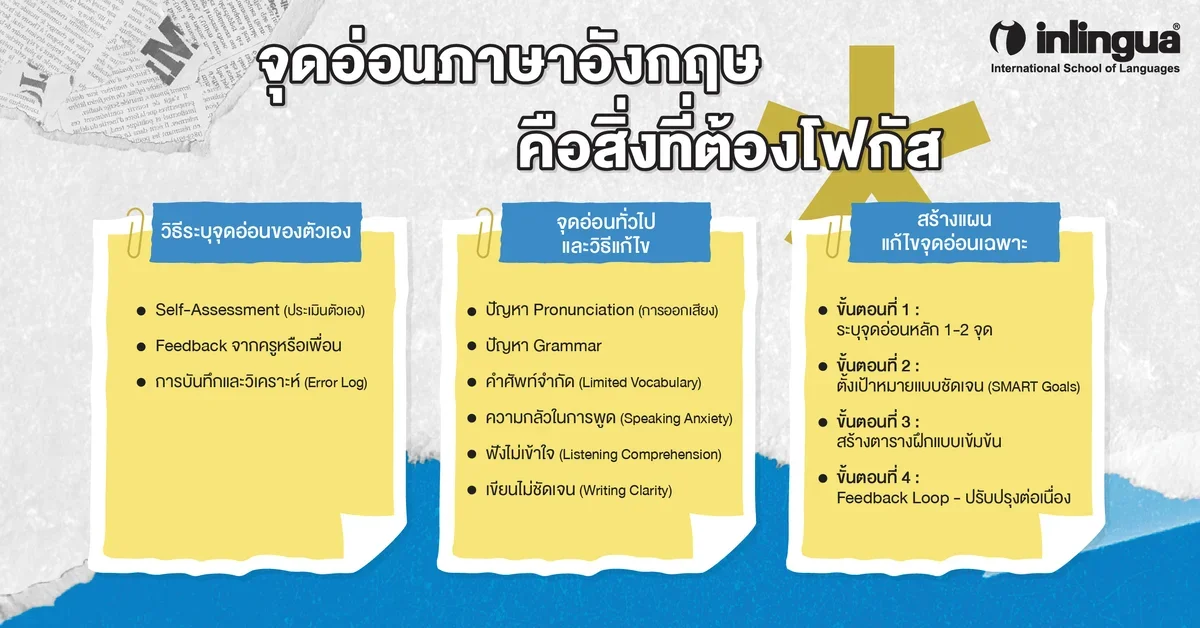
1. How to identify your own weaknesses
To address your weaknesses, you need to start by “knowing what your weaknesses are.” Many people try to train hard, but when they don’t know where to train, it’s like running in place. This section will help you figure out where you really need to focus.
1. Self-Assessment
Test your four key skills with these simple questions: Speaking
- Can I speak fluently?
- Is the pronunciation correct?
- Do you stop and think too often when speaking?
- Are you afraid to speak in front of others?
- Do you often use the same words repeatedly?
Listening
- How well do you understand native speakers?
- How many times do I have to listen to it to understand it?
- Did you get the gist?
- Are you confused by different accents?
Reading
- Are you reading fast enough?
- Can you understand without translating every word?
- Can you guess the meaning from the context?
- Can you read more difficult content?
Writing
- Is it written grammatically correct?
- When you write, will readers understand it?
- Can you use conjunctions and complex sentences?
- Are there a variety of writing patterns?
Rate each item: 5 = very good, 4 = good, 3 = average, 2 = weak, 1 = very weak. Scores of 1-2 are “major weaknesses” that need to be addressed before anything else.
2. Feedback from teachers or friends
Sometimes we can't see our own weaknesses, so let someone else help us. Ask your teacher directly: "Can you help me identify my weaknesses and where I should start to work on them?" Or if practicing with a friend/language partner: "Hey, can you tell me which part of my English sounds unnatural or confusing?" 💡 Tip: Don't be afraid of criticism, because the most direct feedback is often the best gift for those who want to improve.
3. Recording and Analysis (Error Log)
Record yourself talking
- Choose a 3-5 minute speaking topic.
- Listen again and note any points you feel unsure about, such as:
- Wrong grammar
- Mispronunciation
- Use repeated words
- Stuttering
Example Error Log:
| date | Error | Notes / Points to be adjusted |
|---|---|---|
| October 22, 2025 | “I went yesterday” → “I went yesterday” | Grammar (past tense) |
| October 22, 2025 | “thank” → pronounced like “tank” | Pronunciation (th sound) |
| October 22, 2025 | Use “very” a lot | Vocabulary variety |
When written like this, you can see a clear pattern of where mistakes tend to recur. 💡 Tips: Review the Error Log weekly to focus on fixing the most common errors. Read more: Learn English intensively. What should I do if I want to become proficient quickly?
2. Common weaknesses and solutions
Once you know what your weaknesses are, the next step is to “address them at the right points.” Because your development isn't determined by how much you study, but by whether you practice the right things that are causing your weaknesses. In this section, we'll focus on 6 common weaknesses among Thais, along with training guidelines for real results.
1. Pronunciation problems
A slight mispronunciation can cause the listener to misunderstand the entire sentence, and is mostly caused by “not knowing the correct position of the tongue or lips.” Common mispronunciations:
- TH sounds:
- ❌ “think” → “tink”
- ✅ Place your tongue against your upper teeth and blow air gently.
- Practice words: think, thank, three, through, this, that
- R vs L:
- ❌ “rice” → “lice”
- ✅ R: The tongue rolls without touching the roof of the mouth, L: The tongue touches the roof of the mouth lightly.
- Practice words: right / light, read / lead, berry / belly
- V vs W:
- ❌ “very” → “wery”
- ✅ V: Upper teeth touching lower lip, W: O-shaped mouth
- Practice words: very / wary, vest / west, vine / wine
Effective training methods:
- Open the native speaker video and observe the mouth movement.
- Shadowing for 10 minutes a day.
- Record yourself and compare it to the original.
- Practice in front of a mirror to see your tongue and lips.
Training apps:
- ELSA Speak – Automatically analyzes audio output
- Forvo – Listen to native speakers speak for real.
- YouTube channel Rachel's English / BBC Learning English
2. Grammar problems
Grammar is the skeleton of a language, but most people often use it incorrectly because they “memorize the rules but never actually use them.” Common mistakes:
- Tense:
- ❌ I go to London last year. → ✅ I went to London last year.
- ❌ I am work here for 3 years. → ✅ I have worked here for 3 years.
- Articles:
- ❌ I want to be a doctor. → ✅ I want to be a doctor.
- ❌ I went to the Chiang Mai. → ✅ I went to Chiang Mai.
- Prepositions:
- ❌ I arrived to Bangkok. → ✅ I arrived in Bangkok.
- ❌ I'm good in English. → ✅ I'm good at English.
Solution:
- Identify common mistakes (e.g. Tense, Article, Preposition)
- Review the rules + do 20 exercises/day
- Write 10 sentences of your own based on that rule.
- Let the teacher check and correct it.
- Review again next week.
💡 Tips: Don't just memorize the rules. You have to "write and speak" so that your brain connects them to real-world use. Training resources:
- English Grammar in Use (Cambridge)
- Perfect English Grammar (website)
- Grammarly App – Check grammar instantly
3. Limited Vocabulary
If you keep using the same words – good, bad, very, nice – your sentences will be “communicative but not outstanding.” How to systematically expand your vocabulary:
- Start with the most frequently used words (High-frequency words)
- Add collocations such as make a decision / take a break / give a presentation.
- Practice synonyms to avoid repetition.
Example: Instead of the word good → great, excellent, impressive, outstanding instead of words bad → terrible, awful, disappointing Technique: Use the Spaced Repetition principle – review before you forget (via an app like Anki or Quizlet) and create your own “Word Journal” – write a new word every day, along with example sentences.
4. Fear of speaking (Speaking Anxiety)
You can speak in your head, but you can't speak in front of other people. This is a very common "English phobia." Causes:
- Afraid of saying the wrong thing and being laughed at
- Not confident in the accent
- Lack of real speaking experience
Solution:
- Start in a safe environment, such as one-on-one with a teacher.
- Talk about familiar topics first, such as introducing yourself or your hobbies.
- Practice speaking to yourself every day (e.g., saying what you do each day in English).
- Increase the difficulty level in increments, such as:
- Week 1: Speak for 1 minute
- Week 2: Speak for 3 minutes
- Week 4: Speak for 5 minutes
Real student example: “At first I was really scared, but when the teacher asked me to talk about something I liked, it became more and more fun, and I forgot all about my fear.” – Mr. Joe, 27 Read more: Advantages of one-on-one English lessons
5. Listening Comprehension
One of the most common problems English learners face is “I can understand some words but not the main idea,” or “I understand what the teacher is saying but I can’t understand a native speaker at all.” Listening is a skill that takes time and consistent practice, but if you practice it correctly, you’ll start to understand it faster within a few weeks. The main reasons:
- I only listen in class, but not in everyday life.
- Never heard of various accents
- Few words make it difficult to understand even if you can catch the words.
How to practice listening to improve:
- Practice step by step:
- Level 1: Listen slowly (0.75x speed)
- Level 2: Normal listening
- Level 3: Listen fast (1.25x speed)
- Level 4: Listen to a variety of accents such as US, UK, AUS.
- Practice “Active Listening,” not just listening:
- Listen with transcript for the first time
- Listen to it a second time without looking at the script.
- Write down the keywords you hear.
- Listen again only to the points you missed.
- Practice shadowing (speaking aloud)
- Listen in real situations:
- Podcasts on the go
- YouTube English instead of Thai clips
- Change Netflix subtitles to English
Recommended listening practice resources:
- VOA Learning English – Slow content, easy to understand
- BBC 6 Minute English – Practice conversations and new vocabulary
- TED Talks – Develop your listening skills and practice grasping complex concepts.
💡 Tips: Practicing for 15-30 minutes a day is better than listening for 3 hours straight, because the brain needs more “repeated review” than a single dose.
6. Writing Clarity
Another point that many people get stuck on is "knowing a lot of vocabulary but not being able to organize it into sentences" or "being able to write a lot but readers not understanding". Good writing doesn't depend on difficult vocabulary, but on "clarity" and "easy-to-read structure". Good writing structure:
- Introduction:
- Tell the topic (Topic sentence)
- Give a brief overview
- Body Paragraphs (2-3 paragraphs):
- Enter the main idea
- Give an example or supporting reasons.
- Conclusion:
- Summary of main points
- Add your personal comments (if any)
Techniques for writing more clearly:
- Use short sentences (15-20 words per sentence).
- 1 paragraph = 1 point
- Use conjunctions to make it smooth: however, therefore, moreover, for example.
- Always check grammar before submitting.
💡 Tip: If you're unsure whether your writing sounds good, try reading what you've written out loud. If it feels "stuttery," the sentence may be too long or confusing. Writing Help:
- Grammarly / Quillbot – Check grammar and duplicate words
- Hemingway Editor – Helps keep sentences concise
- Google Docs Voice Typing – Use speaking instead of typing to create a natural flow.
💡 Final tip: Practice writing for 10-15 minutes a day, such as a short journal entry about your day, then have a teacher or a native English-speaking friend check your writing, revise, and rewrite. You'll see noticeable improvements within a month. Read more: Arrange your English study time to fit into your daily life.
3. Create a plan to address specific weaknesses.
Simply knowing your weaknesses isn't enough. You need an "action plan" to move from knowing to doing. Addressing your weaknesses will only be effective if you "train with purpose and measurable results."“
Step 1: Identify 1-2 key weaknesses.
Don't try to fix everything at once, as this will confuse your mind and leave you feeling drained. Start with the weakest and most impactful things. For example:
- Weakness #1: Pronunciation (TH, R, L sounds)
- Weakness #2: Grammar (frequent tense errors)
💡 Tips: Choose weaknesses that can have “observable results” such as listening more clearly, speaking more fluently, or making fewer mistakes in writing.
Step 2: Set clear goals (SMART Goals)
Good goals should be measurable and have a specific time frame. For example, set a goal: to improve pronunciation (TH, R, L) and improve grammar tense 50% within 30 days. How to measure:
- Record yourself speaking every week → Compare clarity
- Do grammar test exercises twice a week.
- Give the teacher feedback after every lesson.
💡 Tips: Don't judge by feelings, use "real evidence" such as scores, recordings, feedback.
Step 3: Create an intensive training schedule.
Example 4-week schedule (30 minutes/day + 3 days/week of teacher study):
| day | Things to do | period |
|---|---|---|
| Monday - Friday | Pronunciation drill (th, r, l) | 15 minutes |
| Monday - Friday | Grammar exercise (Tense) | 15 minutes |
| Tuesday / Thursday / Saturday | Class with teacher (focus point) | 90 minutes |
| week | Review & Record yourself | 30 minutes |
Total time: 30 minutes/day + 4.5 hours/week with teacher 💡 Tips: Choose a specific time each day, such as “after dinner” or “before bed,” to create a consistent habit.
Step 4: Feedback Loop – Continuous Improvement
Training without feedback = traveling without a map, because you won't know if you're on the right track. Do this every week:
- Review progress with teachers
- Adjust the plan according to the weak points.
- Continuously collect error logs
Every 2 weeks:
- Take a mini test
- Record yourself again
- Compared to the first week
The result is that you will “see tangible improvements” in your voice, speech, and confidence. Read more: Track your English progress and see if it's getting better.
Fix weaknesses = progress faster
Many people have been studying English for a long time but haven't seen results. This isn't because they haven't studied enough, but because they don't know where to focus. When you know your weaknesses and choose the right training methods, your progress will accelerate exponentially, because every minute you study is "on point."“
Top weaknesses of English learners
- Pronunciation – mispronunciation, not being able to hear yourself
- Grammar – Using the wrong tense, speaking without confidence
- Limited Vocabulary – Repetitive words, overly simple words
- Speaking Anxiety – Fear of speaking incorrectly and lack of confidence
- Listening Comprehension – Not understanding native speakers
- Writing Clarity – Writing is unclear and sentences are not organized properly.
The key to faster development
Identify → Focus → Practice → Review
- Identify: Clearly identify weaknesses.
- Focus: 70% time spent fixing specific points
- Practice: Practice regularly every day.
- Review: Check and adjust weekly.
Remember… “English is not a talent, but a skill that can be learned.” People who speak fluently don’t do so because they are good at it from the start, but because they know where to practice.
Let inlingua help you address your unique weaknesses.
Our teachers:
- ✓ Accurately assess weaknesses
- ✓ Tailor the lesson to what you need to address.
- ✓ Track individual progress
- ✓ Provide real-time feedback for every lesson
Learn English one-on-one Special Program: Focus & Fix Plan – Study specific weaknesses such as Pronunciation / Grammar / Speaking. Free consultation:
- Line: @inlinguathailand
- Email: [email protected]
- website: https://www.inlinguabangkok.com/
Stop by Branch near you To plan your initial session with an expert teacher or make a reservation Free Consultation To create a personal Self-Study plan with an inlingua advisor.