
In our society, children often see doctors, police officers, firefighters, or teachers around them every day. But when asked in English, "What are they called?" or "What do they do?", many children can't answer. Yet, these professions are part of daily life and are a great starting point for connecting English with the real world.
Learning vocabulary Community Helpers It's not just about memorizing job titles, but it also helps children understand that...
What roles do the people around them play? How do they contribute to society? And when problems arise, who should children seek help from?
This article compiles... Vocabulary related to occupations and community helpers that children should know. Clearly categorized, with example sentences and practical activities that can be used at home, school, and while exploring the world around us.
This concept is consistent with...Learning through exploring the world.This is used in the inlingua curriculum, which believes that children learn languages best when they are connected to people, places, and real-life experiences, not just in textbooks.
Why do children need to know about Community Helpers?
Real-World Connection
The profession of community helper is something children see every day, whether it's a doctor at the hospital, a police officer on the street, or a teacher at school. When children learn vocabulary from real-life experiences, English becomes less abstract and more of a tool for naming and describing the reality before them. The same principle applies to learning about...Animals around usSomething that children see every day as well.
Career Awareness
Learning about professions from a young age. Help broaden children's perspectives and show them that society has diverse roles and that all professions are important. Some children may begin to discover that they want to be a doctor, a firefighter, or help others in their own way.
Safety & Life Skills
When children understand what police officers do, what firefighters do, and when doctors help, they will immediately know who to ask for help from in emergencies or real-life problems. Children should learn this.Basic safety terminologyThis goes hand-in-hand with learning how to communicate when you really need help.
Language in Context
Learning vocabulary related to professions helps children practice using the language in real-life situations, such as:
- “What do you do?”
- “How do you help people?”
- “I need help.”
Therefore, English is not just about vocabulary, but about having a practical communication skill.
Health Professionals
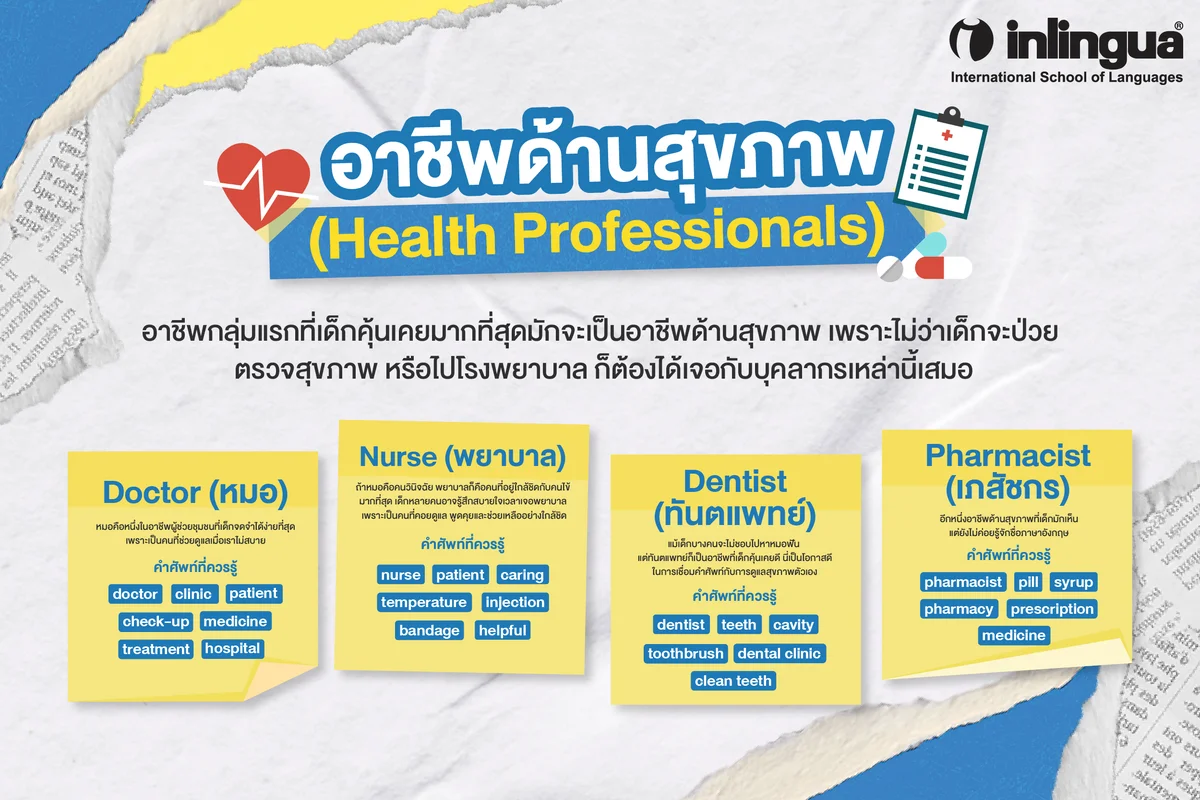
The first group of professions that children are most familiar with are often healthcare professionals, because whether children are sick, having a health check-up, or going to the hospital, they will always encounter these personnel.
Learning vocabulary related to healthcare professions is a great starting point for teaching English through real-life situations that children understand and have experienced firsthand.
Doctor
Doctors are one of the community service professions that children remember most easily because they are the ones who take care of us when we are sick.
Vocabulary you should know
- doctor
- patient
- medicine
- hospital
- clinic
- check-up
- treatment
Explain it in a way that children can easily understand.
- “A doctor helps sick people get better.”
- “Doctors work in hospitals and clinics.”
- “They give medicine and advice.”
Instead of having children memorize things, try inviting them to tell their own stories about how the doctor helped them when they went to the hospital. Children will be able to connect vocabulary with their memories much better this way.
Questions used for speaking practice.
- “What does a doctor do?”
- “How does a doctor help people?”
Nurse
If doctors are the ones who diagnose, then nurses are the ones closest to the patients. Many children may feel comfortable around nurses because they are the ones who provide care, talk to them, and help them closely.
Vocabulary you should know
- nurse
- patient
- bandage
- injection
- temperature
- caring
- helpful
Example sentences
- “Nurses take care of patients.”
- “They check temperature and give medicine.”
Explaining that nurses are people who “care” and not just “give injections” will help children understand the role of this profession more comprehensively.
Dentist
Even though some children may dislike going to the dentist, dentistry is a profession they are quite familiar with. This is a great opportunity to connect vocabulary related to self-care.
Vocabulary you should know
- dentist
- teeth
- toothbrush
- cavity
- dental clinic
- clean teeth
Practical sentences
- “A dentist checks our teeth.”
- “We should brush our teeth every day.”
Parents can use this opportunity to teach both language and health habits at the same time.
Pharmacist
Another healthcare profession that children often see, but whose English name they don't often know.
Vocabulary you should know
- pharmacist
- pharmacy
- medicine
- pill
- syrup
- prescription
Explain in simple terms.
- “A pharmacist gives us medicine.”
- “They work in a pharmacy.”
Try encouraging children to observe who dispenses the medication the doctor prescribes. This will help them understand the collaborative work of various professions within the healthcare system.
Learning vocabulary related to healthcare professions not only helps with language but also helps children understand that when they are unwell, there are many people behind the scenes who are there to help and care for them.
Safety Professionals
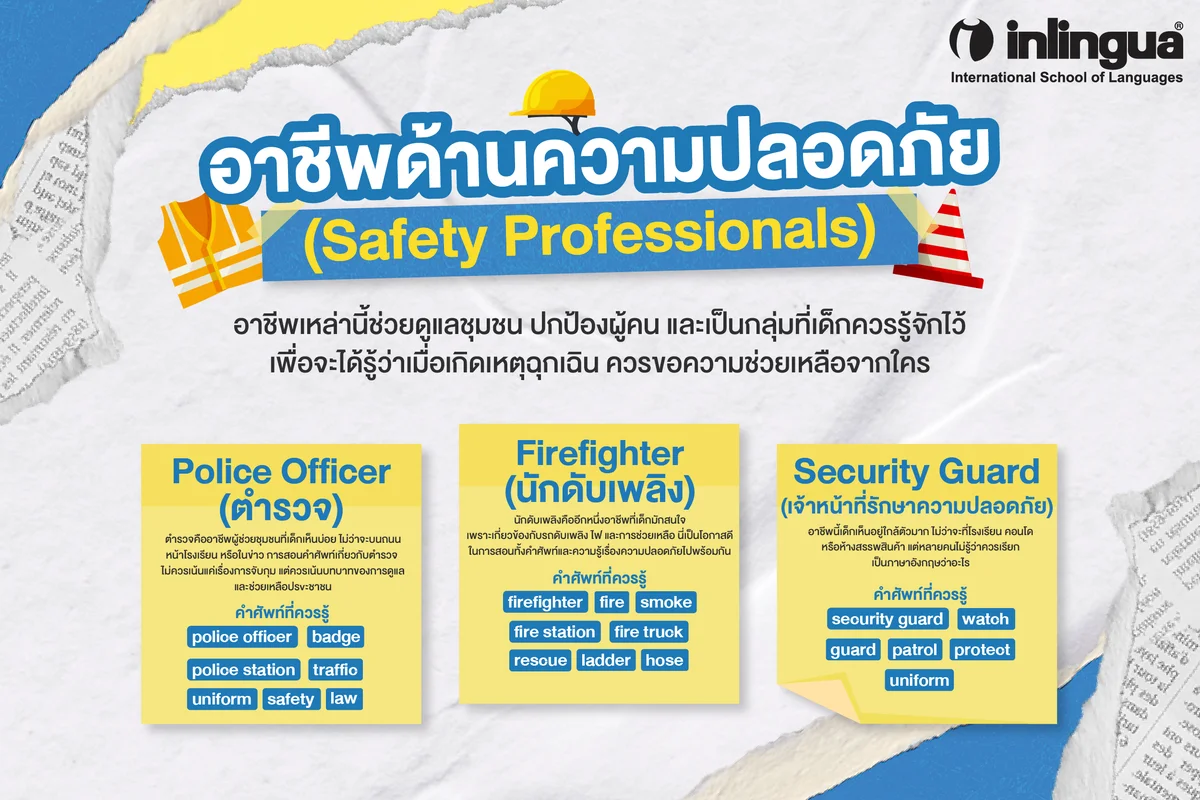
Besides health, another group of professions that children should learn about from a young age are those related to safety.
These professions help maintain communities, protect people, and are groups that children should know about so they know who to ask for help from in emergencies.
Police Officer
Police officers are community workers that children see frequently, whether on the streets, in front of schools, or in the news. Teaching vocabulary related to the police shouldn't focus solely on arrests, but also on their role in caring for and assisting the public.
Vocabulary you should know
- police officer
- police station
- uniform
- badge
- traffic
- safety
- law
Explain it in a way that children can easily understand.
- “Police officers keep people safe.”
- “They help when someone has a problem.”
- “They help control traffic.”
Explaining it this way will help children see police officers as helpers, not people to be afraid of.
Practice the conversation.
- “Can you help me?”
- “I am lost.”
- “Thank you for helping me.”
Firefighter
Firefighters are another profession that children often are interested in because it involves fire trucks, fire, and rescue. This is a great opportunity to teach them both vocabulary and safety knowledge at the same time.
Vocabulary you should know
- firefighter
- fire station
- fire truck
- fire
- smoke
- hose
- ladder
- rescue
Example sentences
- “Firefighters put out fires.”
- “They rescue people from danger.”
- “They are very brave.”
Besides language, parents can incorporate simple lessons, such as what to do if they see a fire and who to ask for help. Children can also learn about...Weather and seasonsThis affects the work of firefighters at different times of the year.
Security Guard
This profession is something children see all around them, whether at school, in condos, or in shopping malls, but many don't know what the correct English term is.
Vocabulary you should know
- security guard
- guard
- protect
- watch
- patrol
- uniform
Explain in simple terms.
- “A security guard protects people and places.”
- “They make sure everyone is safe.”
Teach children that security guards are people they can ask for help from if they get lost or have problems.
Safety-related occupations help children understand both the roles of community members and essential life skills in the real world. When children connect vocabulary to real-life situations, English becomes a tool that helps them feel safer and more confident.
Education Professionals
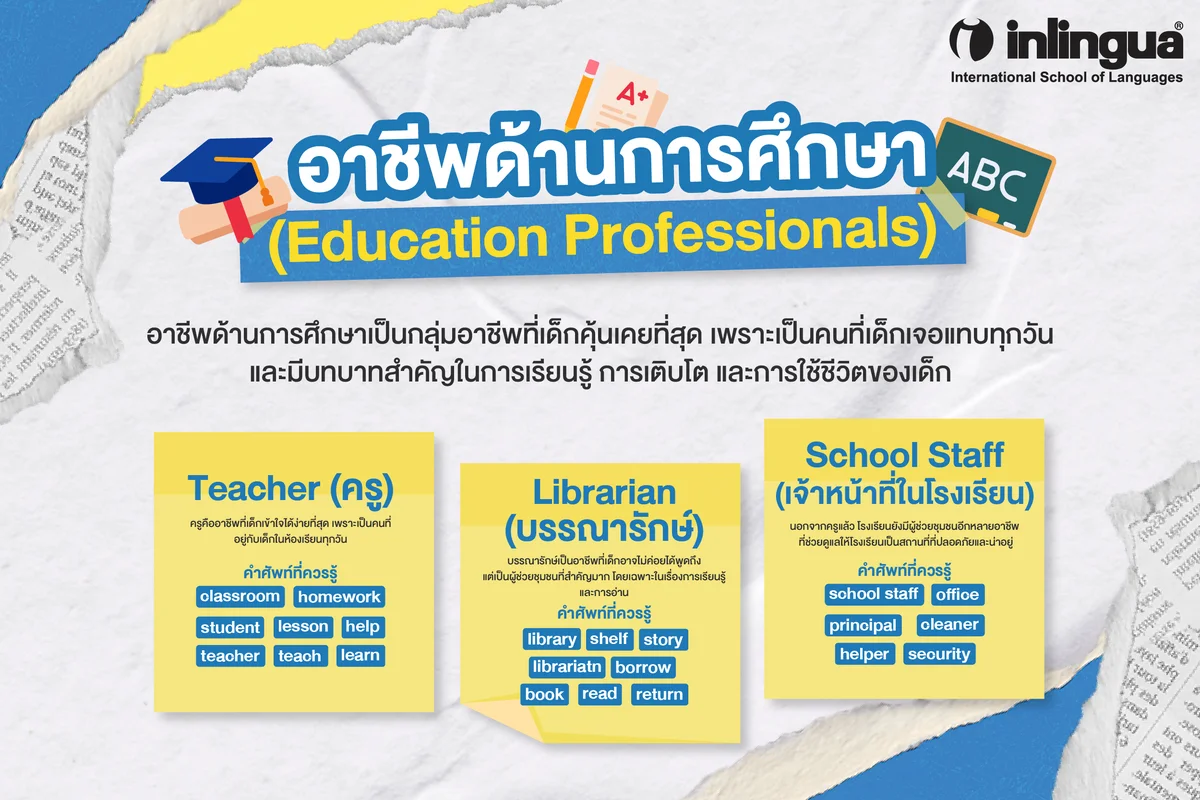
Careers in education are among the most familiar to children because they involve people they encounter almost daily and play a crucial role in their learning, growth, and life.
Learning vocabulary related to this group of professions helps children better describe what happens at school and view learning as something relevant to their lives, not just a duty.
Teacher
Teaching is the profession that children can understand most easily because teachers are the ones who are with them in the classroom every day.
Vocabulary you should know
- teacher
- student
- classroom
- lesson
- homework
- teach
- learn
- help
Practical sentences
- “A teacher helps students learn.”
- “My teacher teaches me English.”
- “Teachers explain new things.”
Parents can encourage children to talk about what their teacher taught them today or how their teacher helped them, so that the children can practice using English in real-life situations.
Librarian
Librarianship is a profession that children may not often talk about, but it is a very important tool for the community, especially in learning and reading.
Vocabulary you should know
- librarian
- library
- book
- shelf
- borrow
- return
- read
- story
Example sentences
- “A librarian works in a library.”
- “They help us find books.”
- “We can borrow books from the library.”
Taking children to the library and having them try speaking simple vocabulary will help them see that English is actually used outside the classroom.
School Staff
In addition to teachers, the school also has community assistants in various professions who help ensure that the school is a safe and pleasant place.
Vocabulary you should know
- school staff
- principal
- office
- cleaner
- helper
- security
Explain in simple terms.
- “School staff help the school run smoothly.”
- “They keep the school clean and safe.”
Teaching children about these professions helps instill respect and shows them that everyone has an important role to play in the school community.
Careers in education don't just teach textbook knowledge; they also teach how to get along with others and help build foundational life skills in children. When children can name these professions in English, they will begin to talk about school and their own experiences with more confidence.
Service Professionals
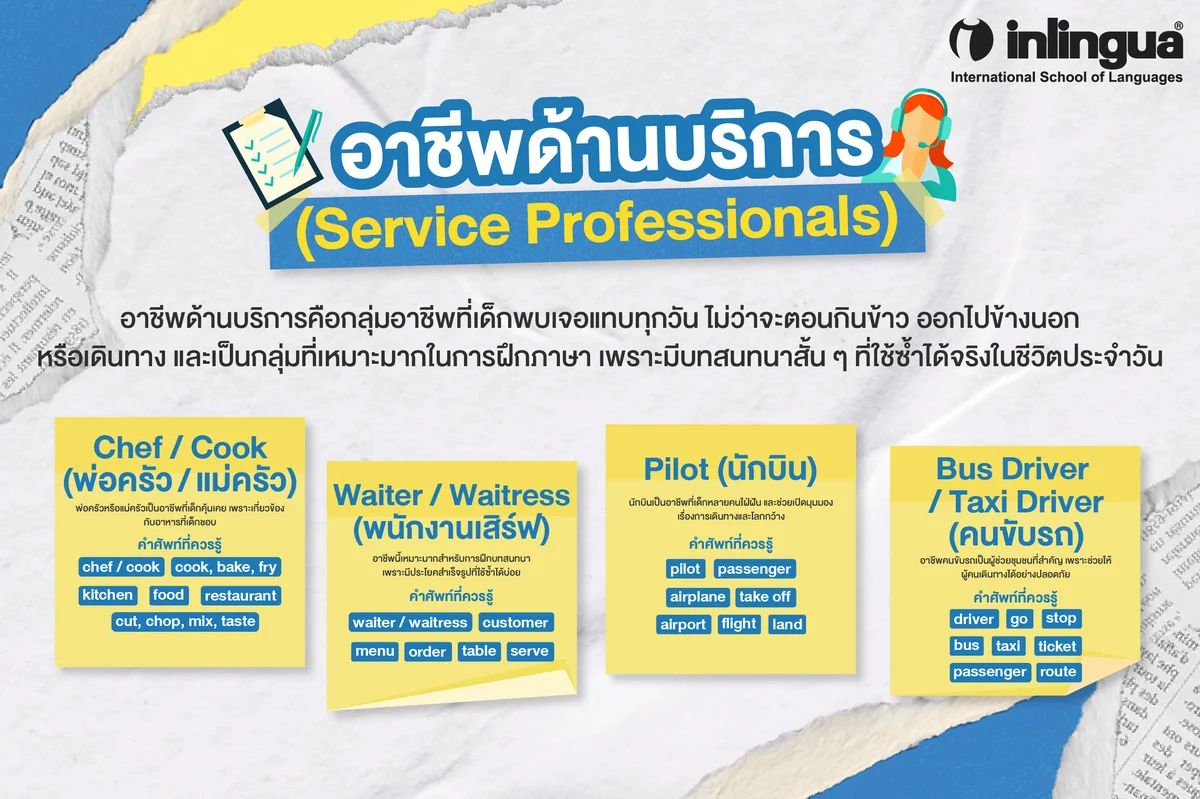
Service-related occupations are those that children encounter almost every day, whether while eating, going out, or traveling. They are also an excellent source for language practice because they involve short conversations that can be reused in real-life situations.
Learning vocabulary related to this group of professions helps children become more confident in speaking and communicating, and simultaneously understand social etiquette.
Chef / Cook
Cooking is a profession that children are familiar with because it involves food that they like.
Vocabulary you should know
- chef / cook
- kitchen
- restaurant
- food
- cook, bake, fry
- cut, chop, mix, taste
Practical sentences
- “The chef cooks food.”
- “The cook works in the kitchen.”
- “This food is delicious.”
Parents can connect this activity with cooking at home, encouraging children to use simple vocabulary while helping prepare meals. English will become a part of daily life without them even realizing it.
Read more: Healthy food in English Here are some food and nutrition terms that you can use right in the kitchen.
Waiter / Waitress
This profession is great for practicing conversational skills because it provides ready-made phrases that can be used repeatedly.
Vocabulary you should know
- waiter / waitress
- menu
- order
- serve
- customer
- table
Example sentences
- “"May I take your order?"”
- “Here is your food.”
- “Enjoy your meal.”
Children can practice role-playing, switching between customer and employee roles, to develop confidence and polite communication skills.
Pilot
Becoming a pilot is a dream job for many children and helps open their perspectives on travel and the wider world.
Vocabulary you should know
- pilot
- airplane
- airport
- flight
- passenger
- take off
- land
Simple sentences
- “A pilot flies an airplane.”
- “Pilots work at the airport.”
Connecting vocabulary with real-life travel experiences helps children understand that English is the language that connects the world.
Bus Driver / Taxi Driver
Drivers are vital community helpers because they ensure people can travel safely.
Vocabulary you should know
- driver
- bus
- taxi
- passenger
- ticket
- stop
- go
- route
Practical sentences
- “The bus driver drives the bus.”
- “Please stop here.”
- “"Thank you."”
Children will begin to see that even short conversations in English help them communicate clearly and politely.
Service-related occupations help children learn to use language in real-life situations, including asking for things, thanking someone, and speaking politely. As children practice repeatedly in daily life, English becomes less about rote memorization and more about developing practical skills for everyday use.
See more: 50 Travel and Transportation Vocabulary WordsThat helps children talk more about vehicles and travel.
Creative Professionals

Creative careers are those that allow children to express their thoughts, imagination, and individuality. They help children enjoy language without feeling like they are "learning."
Artist
Being an artist is a profession that is easily accessible to many children because every child has drawn, painted, or created their own artwork at some point.
Vocabulary you should know
- artist
- paint
- draw
- picture
- color
- brush
- artwork
Practical sentences
- “An artist draws pictures.”
- “I like to paint.”
- “This is my artwork.”
Parents can invite children to draw and then ask them to explain their artwork in simple English. This will help children gain confidence in speaking and feel proud of their work.
Musician
Music is another universal language that can help children learn English naturally.
Vocabulary you should know
- musician
- music
- sing
- play
- instrument
- guitar
- piano
- drum
Example sentences
- “A musician plays music.”
- “I like to sing.”
- “She plays the piano.”
Connecting language with music helps children memorize vocabulary more easily and feel more relaxed while using the language.
Creative careers help children see that English is not just for communication, but also for telling their own stories, expressing their feelings, and sharing their thoughts.
Other important occupations in the community.
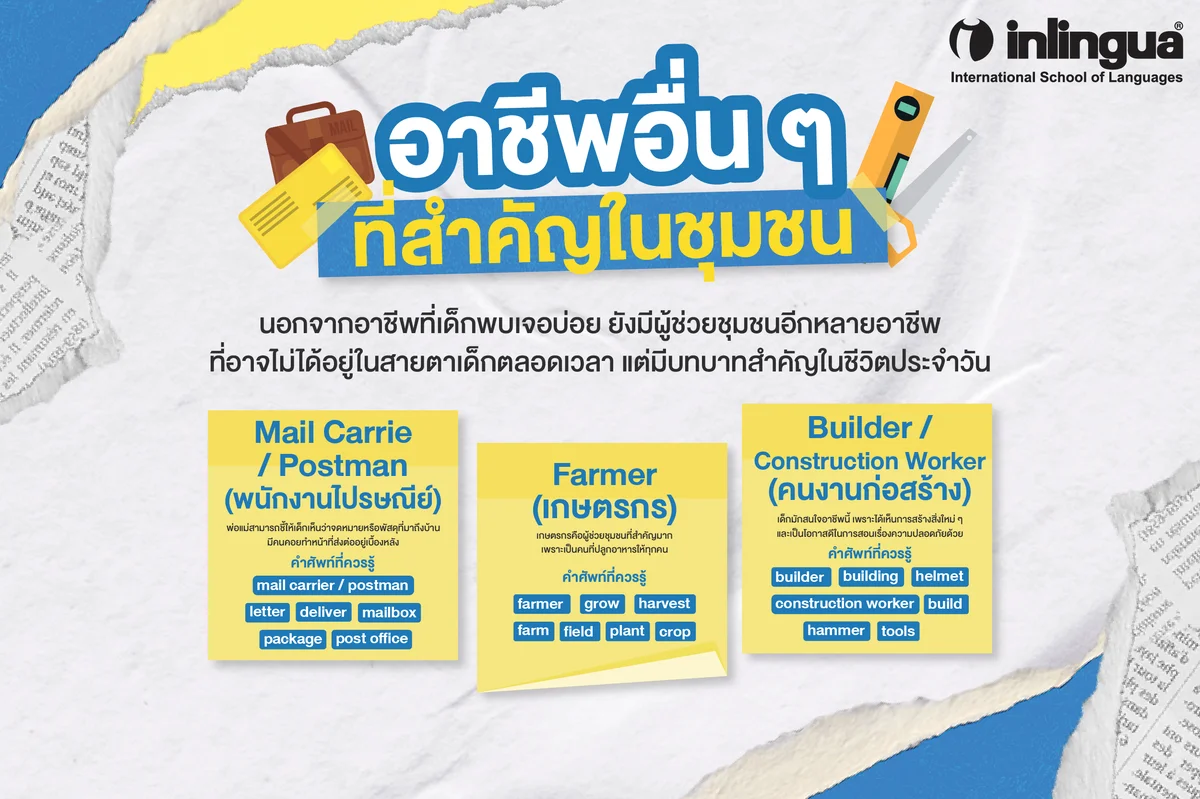
Besides the professions that children commonly encounter, there are many other community service roles that may not always be in a child's sight, but play an important role in their daily lives.
Mail Carrier / Postman
Vocabulary you should know
- mail carrier / postman
- letter
- package
- deliver
- post office
- mailbox
Simple sentences
- “A postman delivers letters.”
- “This is a package.”
Parents can point out to children that there are people behind the scenes who deliver letters or packages that arrive at their homes.
Farmer
Farmers are very important helpers to the community because they are the ones who grow food for everyone.
Vocabulary you should know
- farmer
- farm
- plant
- crop
- field
- grow
- harvest
Example sentences
- “A farmer grows food.”
- “Vegetables come from farms.”
Teaching these vocabulary words helps children appreciate food and understand the origins of the food they eat every day. Children can also build upon this knowledge through further learning.Outdoor nature vocabularyRelated to farms and the crops that farmers grow.
Builder / Construction Worker
Vocabulary you should know
- builder
- construction worker
- build
- tools
- hammer
- building
- helmet
Practical sentences
- “A builder builds houses.”
- “They use tools.”
Children are often interested in this profession because they get to see new things being created, and it's also a great opportunity to teach them about safety.
These professions help children understand that a community requires people from diverse professions to function. Therefore, English is not just about learning vocabulary, but about learning about the world and the people around us.
Community Helpers learning activities
Learning vocabulary related to professions is most effective. When children not just “know words” but get to try using language in situations that are close to real life.
These group activities are designed to allow children to move, talk, and use their imagination without feeling like they are being taught.
Activity 1: Community Helper Dress-Up
Dressing up and role-playing helps children understand professions more quickly and deeply.
method
- Let the children choose a career that interests them.
- Use simple clothes or items you already have at home.
- Have the child introduce themselves.
Sentences used for practice.
- “I am a doctor.”
- “I help sick people.”
- “I work in a hospital.”
Adults don't need to correct mistakes immediately; simply listen and naturally reinforce the correct words. Children will become more confident in speaking over time. Dress-up activities also connect with...Learning English through movement.This helps children memorize vocabulary better through physical expression.
Activity 2: Field Trips & Real-World Observation
Experiencing real-world jobs helps children connect language with the real world most clearly.
A suitable place
- Fire station
- police station
- library
- Restaurants or bakeries
method
- Encourage children to observe what each person is doing.
- Ask simple questions such as:
“What do they do?”
“How do they help people?”
Seeing real objects helps prevent vocabulary from being easily lost and helps it become long-term memory.
Activity 3: Career Day Presentations
This activity is perfect for elementary school-aged children who are starting to want to tell stories and explain things.
method
- Let the children choose the profession they want to be.
- Help children prepare simple vocabulary and sentences.
- Have the child present themselves in front of their family or friends.
Example sentences
- “I want to be a firefighter.”
- “I help people.”
- “My job is important.”
You don't need to be a great speaker; simply having the courage to stand up and speak is a significant step in learning a language.
Activity 4: Thank You Cards for Community Helpers
This activity helps teach both language and social values at the same time.
method
- Let the child choose a profession they would like to be grateful for.
- Write a short card with a drawing.
Example sentences
- “Thank you for helping people.”
- “Thank you for keeping us safe.”
Children will learn that English is not just for speaking, but also for expressing positive feelings.
Activity 5: Role Play Scenarios
Simulations help children prepare to use language in real life.
Example situation
- The child is sick, go to the doctor.
- A lost child sought help from the police.
- If you see a fire, call the firefighters.
Practice sentences
- “I need help.”
- “Can you help me?”
- “Thank you for your help.”
This type of training helps children gain confidence and know what to do when faced with real-life situations. Role-playing activities become even more fun when...Do it together as a family. Let the grandparents be the patients, the parents be the police officers, and the child be the doctor.
All these activities help Community Helpers vocabulary not just to be words that children memorize, but to become language that they "can use".“
Building Respect for All Professions
One of the key goals of learning about... Community Helpers It's not just about knowing the names of professions in English, but about helping children understand that every profession is valuable and plays an important role in the community.
When children learn that doctors help heal people, police officers help maintain safety, firefighters help in emergencies, teachers help impart knowledge, or farmers help grow vegetables and fruits for everyone, the children will begin...View the society around you with understanding and respect.More
Teaching Values Through Language
Teaching vocabulary related to professions can simultaneously incorporate important values, such as:
- Respect
Teach children that all professions deserve respect. - Gratitude
Teach children to say "Thank you" to people who help them. - Community
Teach children that a community can only thrive because everyone helps by fulfilling their own role.
Simple sentences like "Every job is important" are excellent for instilling this idea in children. Inlingua's English language courses for children. Instill these values through activities specifically designed for children of each age group.
Community helpers are people children see around them every day, but when children can say these professions in English, their world expands instantly.
Learning vocabulary related to professions helps children understand the society around them, know who to ask for help from, and confidently communicate in English in real-life situations.
ImportantlyLearning through real-world contexts. Make English not just about rote memorization, but a skill that children can actually use in their daily lives.
Next Steps for Parents
If you want to start simply, you don't need to prepare anything complicated.
- Point out the occupations you see while traveling.
- Ask short questions like, "What do they do?"“
- Let's practice speaking simple sentences together.
Learning at a gradual pace helps children have fun and reduces pressure.
If you want your child to learn English through exploring the real world and naturally connecting the language with the people around them.
Inlingua offers learning programs for children that focus on... community exploration Let your children learn English through real-life experiences, with expert teachers and age-appropriate activities.
We can start by...
- Get a consultation.
- Assess language level.
- And try a trial lesson.
👉 See more details at https://www.inlinguabangkok.com/courses/english-young-learner/