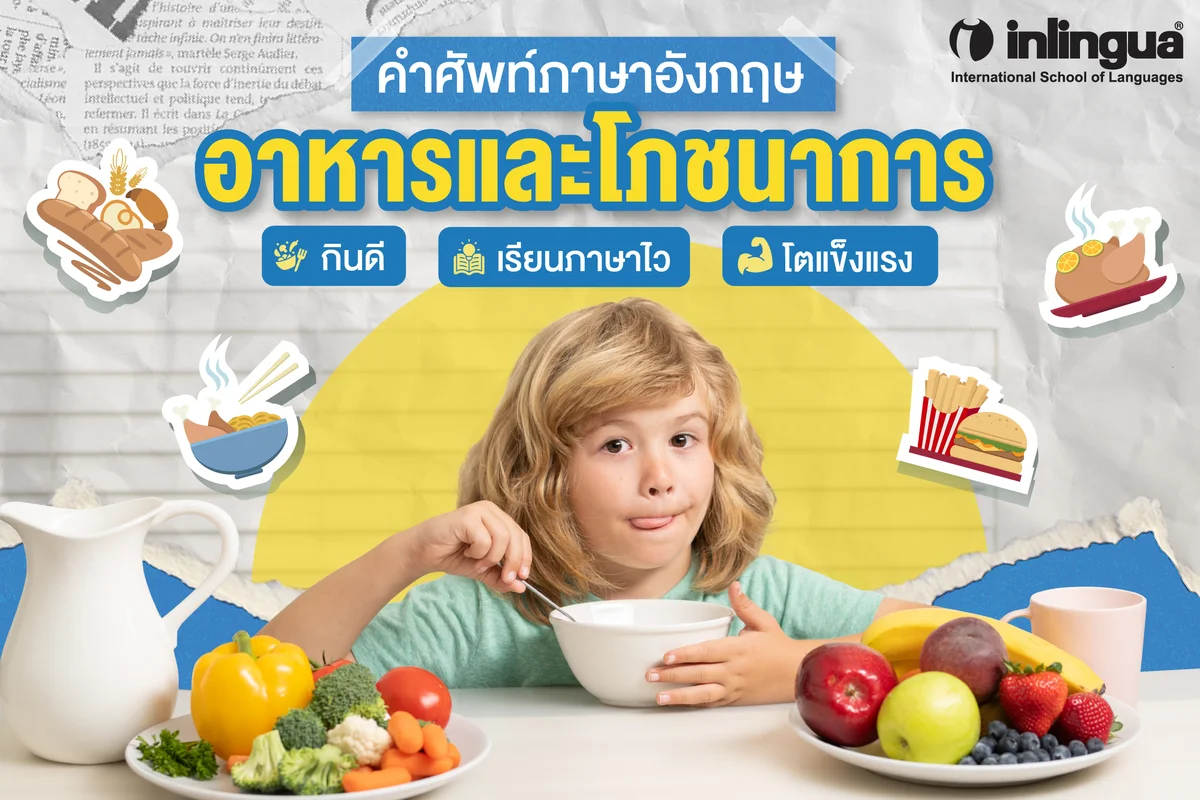
Every child eats several meals a day, but when asked the simple question, "What did you eat today?" in English, many children can't answer, even though it's something so familiar in their daily lives. Food is right in front of them, they see it every day, they touch it every day, but language isn't yet connected to these experiences.
This is why "food and nutrition" is an excellent topic for children's English language learning. Learning through food is relatable; children don't need to use their imagination because what they're learning is what they're actually eating. They see the colors of vegetables and fruits, smell the food, hear the sounds of cooking, and taste it themselves. English, therefore, isn't just about vocabulary, but a language that naturally connects with all five senses.
This article will introduce children to English food vocabulary, along with the basics of nutrition and healthy eating. It covers the five food groups, daily meal plans, flavors, cooking methods, and good eating habits. Children will not only learn vocabulary but also begin to understand how choosing healthy foods affects their bodies.
at inlingua We use food-related activities as part of our English language learning for children, whether it's cooking simple dishes, role-playing in a restaurant, or talking about the food they eat each day. This concept aligns with...Learning through exploring the world.type food exploration This helps children develop language skills along with life skills and build a positive relationship with food from a young age.
Why learn English through food?
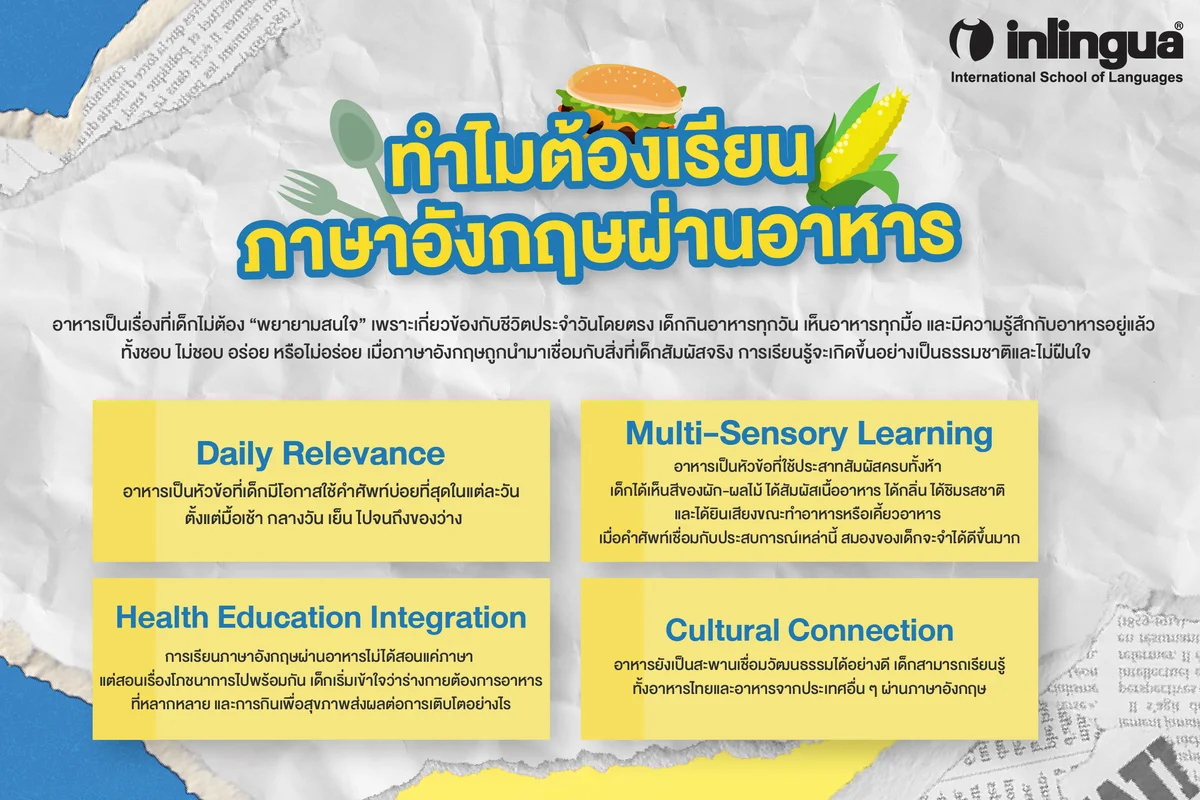
Food is something children don't need to "try to pay attention to" because it's directly related to their daily lives. Children eat every day, see food at every meal, and already have feelings towards food—like, dislike, delicious, or not delicious. When English is connected to something children actually experience, learning happens naturally and without coercion.
Daily Relevance
Food is one of the topics children encounter most frequently throughout the day, from breakfast, lunch, and dinner to snacks. Children can talk about what they're eating right now, without waiting for class. Asking simple questions like "What did you eat today?" or "What do you like to eat?" in English helps children use the language repeatedly in real-life situations. Vocabulary doesn't disappear after school. But it is gradually becoming a part of daily communication.
Multi-Sensory Learning
Food is a topic that engages all five senses. Children see the colors of fruits and vegetables, feel the texture of food, smell the aroma, taste the flavors, and hear the sounds of cooking or chewing food.English vocabulary is connected to these experiences. Children's brains remember things much better. They don't memorize from written words, but from feelings, such as sweetness, crunchiness, or warmth. English is therefore alive, not just words in a book.
Health Education Integration
Learning English through food doesn't just teach the language, but also nutrition. Children begin to understand that their bodies need a variety of foods and how healthy eating affects their growth. As children learn...Vocabulary related to healthy food. English will become a tool for building good behavior. Children will not only be able to speak the language, but will also begin to think and choose food more rationally.
Cultural Connection
Food also serves as a great bridge between cultures. Children can learn about both Thai and other cuisines through the English language. They will begin to understand that each country has different dishes, and that food reflects the lifestyles of its people. Talking about food in English, therefore, doesn't stop at vocabulary; it helps children broaden their perspectives, learn about diversity, and confidently share their own culture with others. Furthermore, food changes over time.Seasons and festivals For example, ice cream in the summer, hot soup in the rainy season, or hot chocolate in the winter.
The Five Food Groups
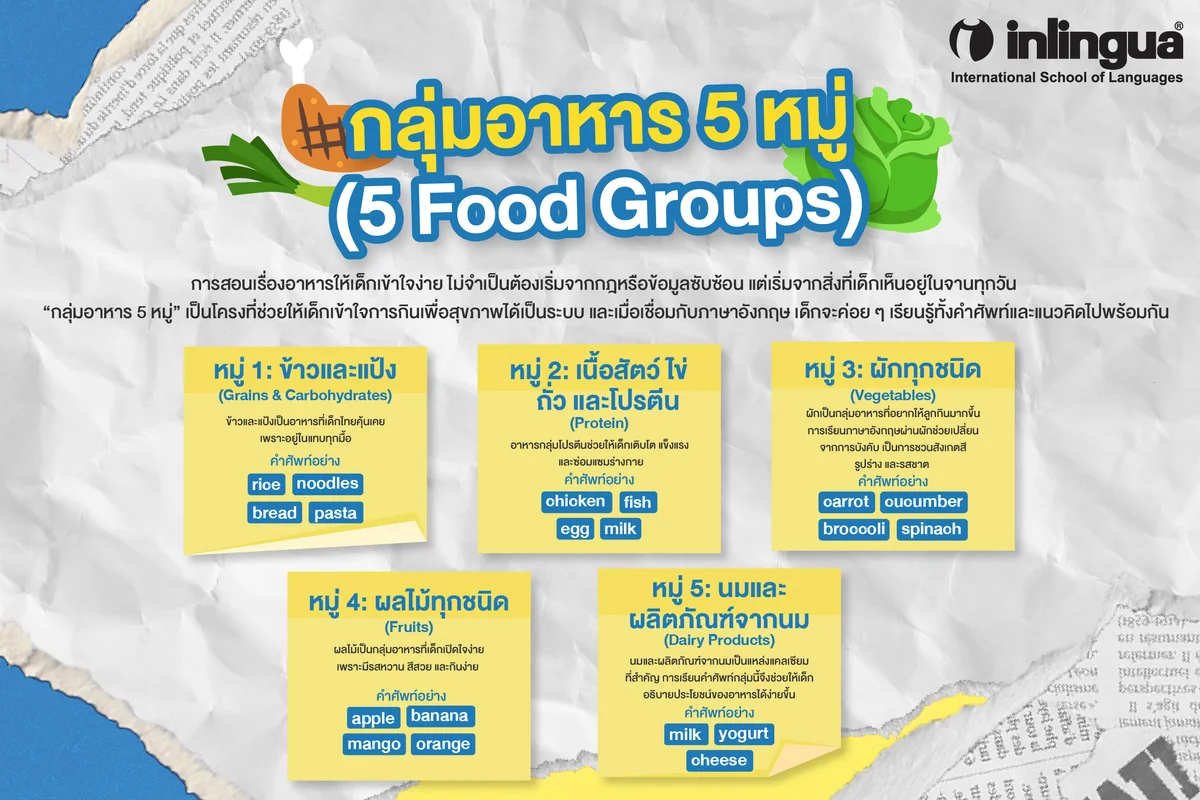
Teaching children about food in a simple way doesn't need to start with complex rules or information. It can begin with what they see on their plates every day. The "five food groups" framework helps children understand healthy eating systematically. When combined with English, children gradually learn both vocabulary and concepts. Instead of stating which foods are good or bad, discussing food groups helps children see diversity and understand that their bodies need a variety of foods, not just one type.
Group 1: Grains and Carbohydrates
Rice and flour are the foods that Thai children are most familiar with, as they are included in almost every meal. Vocabulary such as... rice, bread, noodles or pasta Therefore, it is a word that children can use immediately in their daily lives.
Explaining that rice and starch provide energy helps children understand why we eat rice every day. Simple sentences like...
“I eat rice every day.”
or
“Bread gives us energy.”
Help connect English with the reasons for eating, not just memorizing food names.
Group 2: Meat, eggs, beans, and protein.
Protein-rich foods help children grow, become strong, and repair their bodies. Children are often familiar with terms like... chicken, fish, egg, or milk Since that's already the case, learning this group of words isn't difficult.
Talking to children can start with short sentences, such as:
“Chicken is good for you.”
or
“Eggs help you grow strong.”
When children begin to understand that protein comes from many sources, including meat and legumes, they become more open to a wider variety of foods. Children can connect this knowledge with...200 Animal Vocabulary WordsTo understand which animals are a food source for humans and which live in the wild.
Group 3: All types of vegetables.
Vegetables are a food group that many parents want their children to eat more of. Learning English through vegetables changes the atmosphere from coercion to encouraging observation of colors, shapes, and flavors.
Vocabulary such as carrot, broccoli, cucumber or spinach It often comes with simple descriptions, such as the color or the crunchiness. A child might say,
“Carrots are orange and crunchy.”
or
“I eat vegetables every day.”
English, therefore, helps make vegetables not boring, but something that children can talk about, explain, and gradually become familiar with.
Group 4: All kinds of fruits.
Fruits are a food group that children find easy to accept because they are sweet, have attractive colors, and are easy to eat. Here are some English words for fruit: apple, banana, mango, or orange Therefore, it is a word that children learn quickly.
Talking about fruits helps children learn descriptions of flavors, such as: sweet, sour, or juicy Sentences like...
“I like sweet fruit.”
or
“"Oranges have vitamin C."”
It helps children connect language with nutritional knowledge without feeling like they're learning.
Group 5: Milk and Dairy Products
Milk and dairy products are important sources of calcium. Children are often familiar with them. milk, yogurt, and cheese Learning this vocabulary will therefore help children explain the benefits of food more easily.
Sentences like...
“Milk makes our bones strong.”
or
“Yogurt is good for your body.”
Help children begin to connect eating with taking care of their own bodies.
Meals and Time
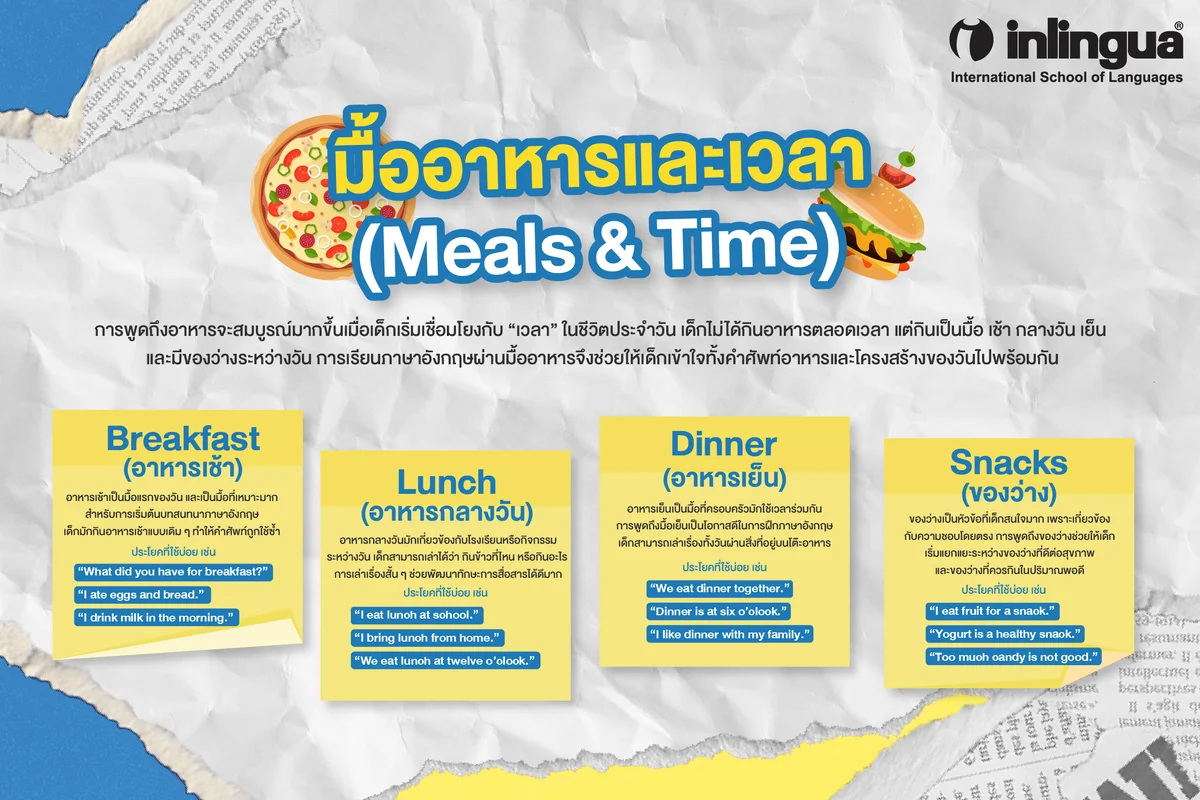
Learning about food becomes more complete when children begin to associate it with “time” in their daily lives. Children don’t eat all the time, but rather in meals—breakfast, lunch, dinner—and snacks between meals. Learning English through mealtimes therefore helps children understand both food vocabulary and the structure of the day simultaneously.
Asking simple questions about meals is a great way to practice English because the questions are based on real-life experiences, requiring minimal thought, and can be repeated daily.
Breakfast
Breakfast is the first meal of the day and a great way to start an English conversation. Children often eat the same breakfast foods, leading to natural repetition of vocabulary.
Commonly used phrases include:
“What did you have for breakfast?”
“I ate eggs and bread.”
“I drink milk in the morning.”
Talking about breakfast also helps children understand the concept of starting the day and learn why breakfast is important for energy and concentration in school.
Lunch
Lunchtime stories are often associated with school or daytime activities. Children can describe where they ate, with whom, or what they ate. Telling short stories like this is excellent for developing communication skills.
Example sentences that are easy for children to use, such as:
“I eat lunch at school.”
“I bring lunch from home.”
“We eat lunch at twelve o'clock.”
English at lunchtime is therefore not just about food, but it's also connected to time, place, and the children's daily routine.
Dinner
Dinner is often a mealtime when families spend time together. Talking about dinner is a great opportunity to practice English in a relaxed atmosphere. Children can tell stories about the day through what's on the dinner table.
Simple, commonly used sentences such as:
“We eat dinner together.”
“Dinner is at six o'clock.”
“I like dinner with my family.”
Using English during this time helps connect the language with a warm feeling, not just in the classroom. Even dinner is part of it.Activities that the whole family can enjoy together. Encourage grandparents to talk about food with their grandchildren in English.
Snacks
Snacks are a topic that children are very interested in because they are directly related to their preferences. Talking about snacks helps children begin to differentiate between healthy snacks and snacks that should be eaten in moderation.
Practical sentences such as:
“I eat fruit for a snack.”
“Yogurt is a healthy snack.”
“Too much candy is not good.”
Discussing snacks in English is a great way to subtly introduce the concept of healthy eating without making children feel ordered or forced.
Cooking verbs
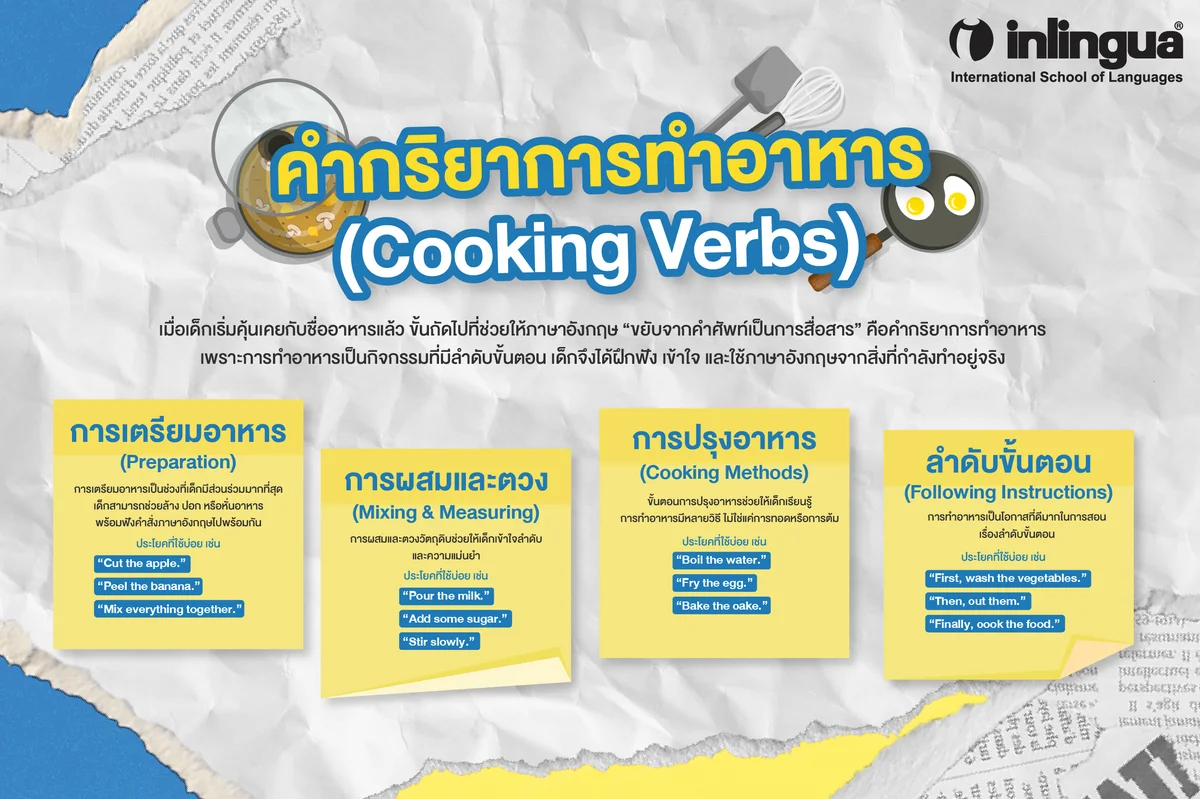
Once children become familiar with food names, the next step that helps English "move from vocabulary to communication" is learning cooking verbs. Because cooking is a step-by-step activity, children practice listening, understanding, and using English from what they are actually doing.
Learning cooking verbs doesn't require a big kitchen. Just cooking simple dishes or helping prepare ingredients is enough for children to use English naturally.
Food preparation
The food preparation process is where children can participate the most. They can help wash, peel, or cut food while listening to instructions in English.
Common verbs used in this step include: cut, chop, slice, peel, or mix Parents or teachers might say short sentences like...
“Cut the apple.”
“Peel the banana.”
“Mix everything together.”
When children follow instructions in real-life situations, English becomes connected to the action. They don't need to translate in their heads; they understand immediately from the context.
Mixing and Measuring
Mixing and measuring ingredients helps children understand sequence and precision. Children will begin to become familiar with verbs such as... stir, pour, add, and measure
Practical sentences such as:
“Pour the milk.”
“Add some sugar.”
“Stir slowly.”
This activity also helps children practice listening to multi-step instructions, a crucial skill in developing English language skills.
Cooking Methods
The cooking process helps children learn that there are many ways to cook, not just frying or boiling. Verbs like... boil, fry, bake, grill, or steam It often appears in daily life.
Children may hear simple sentences such as:
“Boil the water.”
“"Fry the egg."”
“Bake the cake.”
When these verbs are used repeatedly, children will begin to understand both the language and the cooking process at the same time.
Instructions
Cooking is a great opportunity to teach children about sequences. They will hear words like... first, then, and finally This is an important conjunction in the English language.
Examples of practical sentences include:
“First, wash the vegetables.”
“Then, cut them.”
“"Finally, cook the food."”
The English in this section helps children not only to follow instructions, but also to begin describing the “steps” in English.
Kitchen tools
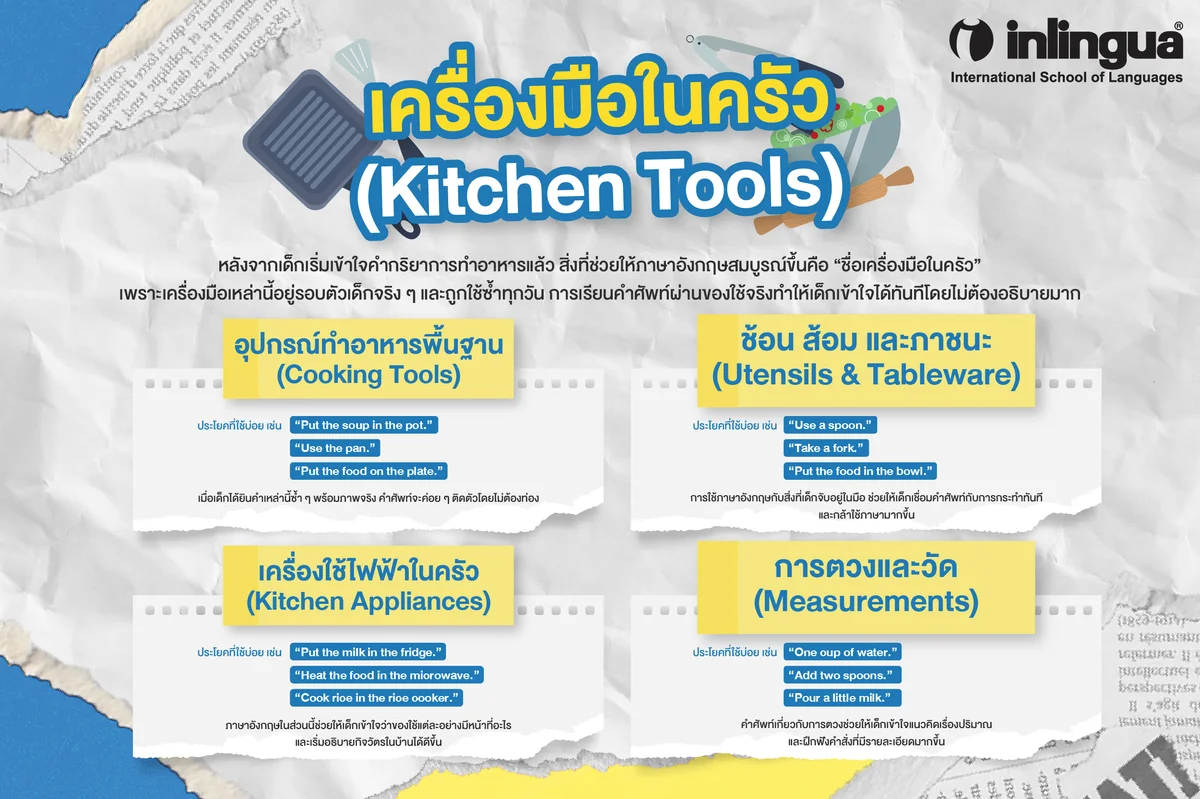
After children begin to understand verbs for cooking, what helps to complete their English learning is "the names of kitchen tools," because these tools are actually around the children and are used repeatedly every day. Learning vocabulary through real-world items allows children to understand immediately without much explanation.
Pointing to kitchen utensils and naming them in English is a very easy and natural way to learn. Children don't feel like they're learning, but rather actively participating in what's happening in front of them.
Basic cooking tools
Basic utensils like pots, pans, or knives are things children often see adults use. While children may not use them all themselves, they can learn through observation and helping with simple tasks.
Parents or teachers might say short phrases while cooking, such as:
“Put the soup in the pot.”
“Use the pan.”
“Put the food on the plate.”
When children hear these words repeatedly, accompanied by real-life images, the vocabulary will gradually stick with them without needing to memorize them.
Spoons, forks, and utensils (Utensils & Tableware)
Spoons, forks, and plates are items children use every day, making them a great opportunity to practice English during mealtimes.
Simple, practical sentences such as:
“Use a spoon.”
“Take a fork.”
“Put the food in the bowl.”
Using English with objects children hold in their hands helps them connect vocabulary with immediate actions and encourages them to be more confident in using the language.
Kitchen appliances
Kitchen appliances such as refrigerators, stoves, or microwaves are things children see every day. Even if they don't use them themselves, they can learn their names and functions.
Examples of conversations while cooking include:
“Put the milk in the fridge.”
“Heat the food in the microwave.”
“Cook rice in the rice cooker.”
The English in this section helps children understand the function of each object and begin to describe household routines better.
Measurements
Measuring and portioning are steps that help develop accuracy and listening skills. Children may help by scooping or pouring according to simple instructions.
Commonly used phrases include:
“"One cup of water."”
“Add two spoons.”
“Pour a little milk.”
Vocabulary related to measurement helps children understand the concept of quantity and practice listening to more detailed instructions.
Taste and Description of Food
Once children become familiar with food and kitchen utensils, what makes English more "alive" is describing their feelings towards food, because the taste and texture of food are things children actually experience every time they eat it.
Learning this vocabulary helps children go beyond simply saying "what I ate," and begin to say "how was the food?" which is a crucial step in using language to communicate thoughts and feelings.
Basic Tastes
Taste is something children can easily understand because everyone has firsthand experience with it. While children may not be able to explain at length yet, you can start with short words commonly used in daily life.
During meals, parents might start a conversation with simple sentences such as:
“How does it taste?”
“It's sweet.”
“It's sour.”
“It’s salty.”
As children become more familiar with flavors, they begin to compare tastes, such as whether a dish is spicier or less sweet. Therefore, English is used to describe things, not just to give short answers.
Additional flavors and intensity (Flavors)
In addition to basic tastes, food also has other flavors that children begin to recognize, such as spicy, mild, or savory. These words often arise when children express their likes or dislikes of food.
Examples of practical sentences include:
“It’s spicy.”
“"It's not too spicy."”
“This food is very rich.”
Talking about tastes in this way helps children describe their feelings more clearly and reduces the need to use short answers like "like" or "dislike."
Texture
The texture of food is another thing children observe well. They may not know difficult vocabulary, but they immediately understand when food is crispy, soft, or chewy.
Parents can encourage children to observe by asking questions such as:
“Is it crunchy?”
“Is it soft or hard?”
The child might answer that:
“It's crunchy.”
“It's soft.”
These words tend to stick with children easily because they are directly connected to the sensations in the mouth.
Food temperature
Temperature is a simple explanation that can be applied every day. Children learn instantly by eating hot or cold food.
Commonly used phrases include:
“It's hot.”
“It's warm.”
“It’s cold.”
Using English in this context also helps teach about...Safety in daily life For example, waiting for food to cool down before eating, or being careful with knives in the kitchen, without needing a lengthy explanation.
Likes and Dislikes
Talking about the taste and texture of food leads to a natural expression of preferences. Children begin to use English to express their thoughts.
Simple, practical sentences such as:
“I like this.”
“I don't like spicy food.”
“This is delicious.”
Giving children the opportunity to express their feelings helps them use English as a means of communication, not just as something to say correctly.
Healthy Eating Habits
Teaching children about healthy eating doesn't need to start with a lot of rules and prohibitions. It can begin by helping them "understand the reasons" through simple English. When language is connected to real-life behaviors, children will gradually absorb concepts of food and nutrition while developing their language skills.
This topic, therefore, highlights how English serves not only the purpose of communication but also helps cultivate good eating habits in the long term.
Balanced Diet (Eating a balanced diet)
The concept of a balanced diet is easiest to understand when connected to the food in front of them. Children don't need to know deep nutritional details; they just need to understand that we should eat a variety of foods from different food groups.
Practical English phrases for everyday life, such as:
“Eat food from all five groups.”
“Eat vegetables and fruits every day.”
“Food helps our body grow.”
Talking like this helps children understand that healthy eating isn't about eliminating food, but about making a varied and balanced choice.
What to Eat More / What to Eat Less
Telling children what they "should eat more" and what they "should eat less" is a gentler approach than forbidding them. Children will begin to understand how to make their own food choices.
Examples of easy-to-use sentences include:
“Eat more vegetables.”
“Fruit is a healthy snack.”
“Too much sugar is not good.”
The English language content in this section helps children gradually become aware of the effects of food on the body without making eating a stressful experience.
Food Pyramid / MyPlate (Food Portion Arrangement)
Explaining food proportions helps children visualize it clearly. They don't need to memorize numbers; they understand by looking at the overall picture of the food on the plate.
Simple, practical sentences such as:
“Half the plate is vegetables and fruits.”
“This part is protein.”
“This part is rice.”
When children begin to see a plate of food as a whole, English will help them describe and understand healthy eating better.
Hydration (drinking enough water)
Water is essential for health, but children often forget to drink water when they're busy playing. Talking about water in English can help remind children informally.
Commonly used phrases include:
“Drink more water.”
“Water is better than soda.”
“Drink water when it's hot.”
Connecting the topic of drinking water to the weather and daily activities helps children understand that body care changes depending on the circumstances.
Listening to the Body
Another important behavior is teaching children to listen to their bodies. Children should learn to recognize hunger, fullness, or discomfort from certain foods.
Simple sentences that children can use, such as:
“I'm hungry.”
“I'm full.”
“"My stomach hurts."”
The English language content in this section helps children communicate their feelings better, and allows parents to understand their children's needs more clearly.
Food-Based Learning Activities
Once children understand vocabulary related to food, flavors, and the concept of healthy eating, what truly makes learning "stuck" is hands-on experience. Food-related activities help children learn English beyond just listening or reading, making it a language they use in real-life situations.
These activities don't need to be special or complicated. Just shift your perspective from your daily routine to transform it into a natural time for learning English.
Activity 1: Cooking Together
Cooking together is an activity that children can truly participate in. They hear instructions in English and follow them immediately, such as washing, peeling, or mixing ingredients.
While cooking, parents or teachers might use simple phrases such as:
“Wash the vegetables.”
“Peel the banana.”
“Mix everything together.”
When children hear and do things simultaneously, English becomes connected to the action. They don't need to translate in their heads, but understand from the situation at hand. Using the body while learning a language aligns with this.Learning through movement activities.This helps children memorize vocabulary through hands-on activities.
Activity 2: Market Visit (Go to the market or supermarket)
Bringing childrenGo to the market.This is a great opportunity to learn vocabulary from real-life examples. Children get to see a variety of vegetables, fruits, and foods in a live context.
Parents can encourage children to observe and talk about simple things, such as:
“What is this?”
“The tomatoes are red.”
“I like apples.”
Learning in real-world settings helps children remember vocabulary better and start to feel confident using English outside the home. While going to the market, children also get to know...The role of people in the community.For example, merchants, vendors, or farmers who grow vegetables to sell in the market.
Activity 3: Food Sorting Game
Food categorization activities help children understand nutrition informally. Children can separate foods into groups, such as healthy foods and foods that should be eaten in moderation.
While playing, children might use sentences like...
“This is healthy.”
“This has a lot of sugar.”
The English language used in this activity helps children think more critically and explain their food choices better.
Activity 4: Restaurant Role Play
Role-playing in a restaurant is a fun activity for children and encourages them to use language. Children can switch roles between staff and customers.
Commonly used phrases include:
“What would you like to order?”
“I'd like chicken and rice, please.”
“Here you are.”
This activity helps students practice both food vocabulary and social etiquette at the same time.
Activity 5: Food Journal / Diary
Having children keep a record of what they eat each day helps them review vocabulary and observe their own eating habits.
Children may write or speak short sentences such as:
“For breakfast, I ate eggs.”
“I ate fruit for a snack.”
This activity helps develop storytelling skills and allows children to see the connection between language and daily life.
Activity 6: Growing Vegetables
Growing vegetables is an activity that helps children understand the origin of food. They can observe the growth of their produce and learn patience along with language skills.
While taking care of the plants, the child might say:
“The plant is growing.”
“It has new leaves.”
“I water the plant every day.”
The English language component of this activity helps children connect food with nature and appreciate the value of healthy eating from the outset. Children interested in gardening can also build upon this knowledge.100 Outdoor Nature Vocabulary WordsThis helps to describe the trees, soil, water, and environment surrounding the vegetable garden.
Cultural Foods & International Cuisine
Food is not just about filling your stomach; it's a large window through which children learn about the world and different cultures. Learning English through international cuisine helps children understand that people in different countries eat differently, and that food reflects the lifestyle, climate, and culture of each place.
This topic, therefore, helps children use English to “tell stories about food” rather than just memorizing menu names, and also helps broaden their perspective to respect the diversity of the world.
Thai Food Vocabulary (Thai food in English)
Thai food is a great starting point because children are familiar with it and see it every day. Learning the names of Thai dishes in English helps children explain their own culture to foreigners.
Examples of practical speaking examples include:
“Pad Thai is fried noodles.”
“Tom Yum is hot and sour soup.”
“Mango sticky rice is sweet.”
When children can describe Thai food in English, they feel proud and see that English is not something distant, but a tool for telling their own story.
International Foods
Learning about food from other countries helps children open their minds and enjoy the English language more, because they have seen or eaten many of the foods before.
Children can start with simple sentences such as:
“"Pizza is from Italy."”
“"Sushi is Japanese food."”
“Hamburgers are popular in America.”
Connecting food with countries allows children to unconsciously learn vocabulary along with geography and culture.
Comparing Foods
Once children begin to recognize foods from different countries, comparisons are a step that helps develop their language skills to the next level. They might notice that some dishes are spicier, sweeter, or different from Thai food.
Examples of easy-to-use sentences include:
“Thai food is spicy.”
“Japanese food is not very spicy.”
“I like Italian food more.”
The English in this section helps children practice expressing their opinions and learn that everyone has different preferences.
Food as Culture
Talking about food is a starting point for learning about culture. Children will begin to understand that food is not just about taste, but also has a story behind it, such as what occasion it was eaten on, or who they ate it with.
Simple sentences that help children connect this concept include:
“Different countries have different food.”
“Food is part of culture.”
“We eat food together.”
Once children understand this point, English will become a language that connects people, not just a language used in the classroom.
Manners & Etiquette (Dining Etiquette)
Table manners are a life skill that children can use every day, and it's also a great topic for learning English because it involves short phrases that can be repeated frequently. Learning English through eating etiquette helps children communicate politely and understand how to coexist with others in society. Instead of teaching long rules, using simple English during meals allows children to absorb manners along with the language.
Table Manners (Basic table etiquette)
Small behaviors during mealtimes are a great opportunity to practice English. Children can learn polite phrases through practical use at every meal.
Commonly used phrases include:
“Wash your hands before eating.”
“Say please and thank you.”
“Chew with your mouth closed.”
When English is used in real-life situations, children understand the meaning and can use it without feeling like they are being taught.
Polite Phrases at the Table
Politely asking or refusing is an important skill. Children can easily practice this during meals at home.
Examples of practical sentences include:
“May I have some water, please?”
“This is delicious!”
“No, thank you. I'm full.”
These sentences help children communicate their needs clearly and politely at the same time.
At a Restaurant (Restaurant Etiquette)
Taking children to restaurants is a great opportunity to practice English in real-life situations. Children can learn basic conversational phrases that can be repeated many times.
Example sentences that children can use include:
“I would like…”
“Can I have chicken and rice?”
“Is this spicy?”
Activities like these help children gain confidence in using English outside the home and understand social etiquette better.
How inlingua Teaches Food & Nutrition
at inlingua We believe that English language learning for children is most effective when the language is connected to real life. Therefore, lessons on food and nutrition are designed to allow children to see, do, and use the language simultaneously.
Learning Through Real Experience
Children don't just learn from pictures; they also touch real ingredients, cook simple dishes, and speak English while doing so. Therefore, English isn't something to memorize, but something to use for real communication.
Interactive & Hands-On Learning
Learning through activities such as cooking classes or role-playing helps children participate, encouraging them to speak, try, and use English more confidently without fear of making mistakes.
See detailsEnglish language courses for childrenUsing food-related activities as part of the lesson.
Cultural Exchange
The children learned about both Thai food and food from other countries through native-speaking teachers. The Thai children practiced describing their own dishes and learned about new cultures at the same time.
Project-Based Learning
Children engage in simple projects such as writing food journals or recipe books, which helps them practice storytelling, organizing their thoughts, and using English naturally.
Conclusion
Food is one of the topics most familiar to children and a powerful tool for learning English. Children eat every day, see food at every meal, and already have experiences with food. When English is connected to food and nutrition, learning happens naturally.
This article demonstrates how children can learn food vocabulary, basic nutrition, and healthy eating alongside developing their English language skills. Children not only learn to name foods but also begin to describe flavors, choose healthy foods, and confidently communicate about table manners.
When English becomes a part of daily life, children will...Learning is continuous through exploring the world around us. Fun and practical in the long run.
At inlingua, we design English language courses for children that connect language to real life, whether it's food, activities, or life skills. Children learn through experience, not just from books.
If you are looking for a course that will help your child...
- Can use English effectively.
- And learn about the world with confidence.
See details of our English language courses for children here.
👉 https://www.inlinguabangkok.com/courses/english-young-learner/