
Many Thai families are familiar with this scene: grandparents help take care of the grandchildren, parents go to work, and the children get to spend the whole day with the family. But when it comes to English, the adults in the house often feel insecure, afraid of making mistakes or not being able to teach their children and grandchildren. In reality, learning English doesn't need to start with the most proficient person in the house; it can begin with... Learning together.
When children hear their parents or grandparents trying to speak simple English in everyday life, they will feel that making mistakes is not scary and that English is not something daunting.
Family learning helps children gain more confidence, adults learn alongside them, and unconsciously strengthens family relationships.
This article compiles... 15 English activities for families Designed to be truly engaging for all ages. No fluent English or special equipment is required; just spend quality time together and allow English to become a part of daily life.
This concept is consistent with...Learning through exploring the world.Inlingua believes that language is learned best when in real-life context and when it is meaningful to the learner.
Why learning English as a family is effective.
Safe Learning Environment
Home is the safest place for learning. Children dare to try, dare to speak, dare to make mistakes because they know no one will judge or laugh at them.
When adults in the household themselves make mistakes, children immediately learn that "learning a language is about experimentation, not about speaking correctly from the start." In addition to a safe environment, children should also learn...Basic safety terminologyFor use in daily life as well.
Multiple Learning Models
Children learn not only from their teachers, but from everyone around them.
- Children imitate their parents' speech.
- I explained it to my grandparents → The child remembered it better than before.
Teaching others is the most powerful form of learning. And children do this very well naturally.
Real-Life Context
Family-style English isn't sentences from textbooks, but words actually used in daily life.
- While cooking
- When talking about old photos.
- When planning a trip.
Therefore, the English language has "meaning," not just "words."“
Cultural & Emotional Benefits
Collaborative learning helps build bonds between generations. Grandparents feel valued, parents feel involved, children see an example of lifelong learning, and most importantly, children grow up feeling that English is accessible to everyone, not just for the academically gifted. This is the core of...Learning English for children through exploration.At inlingua, this is the main guideline.
Family activities at home (5 Activities)
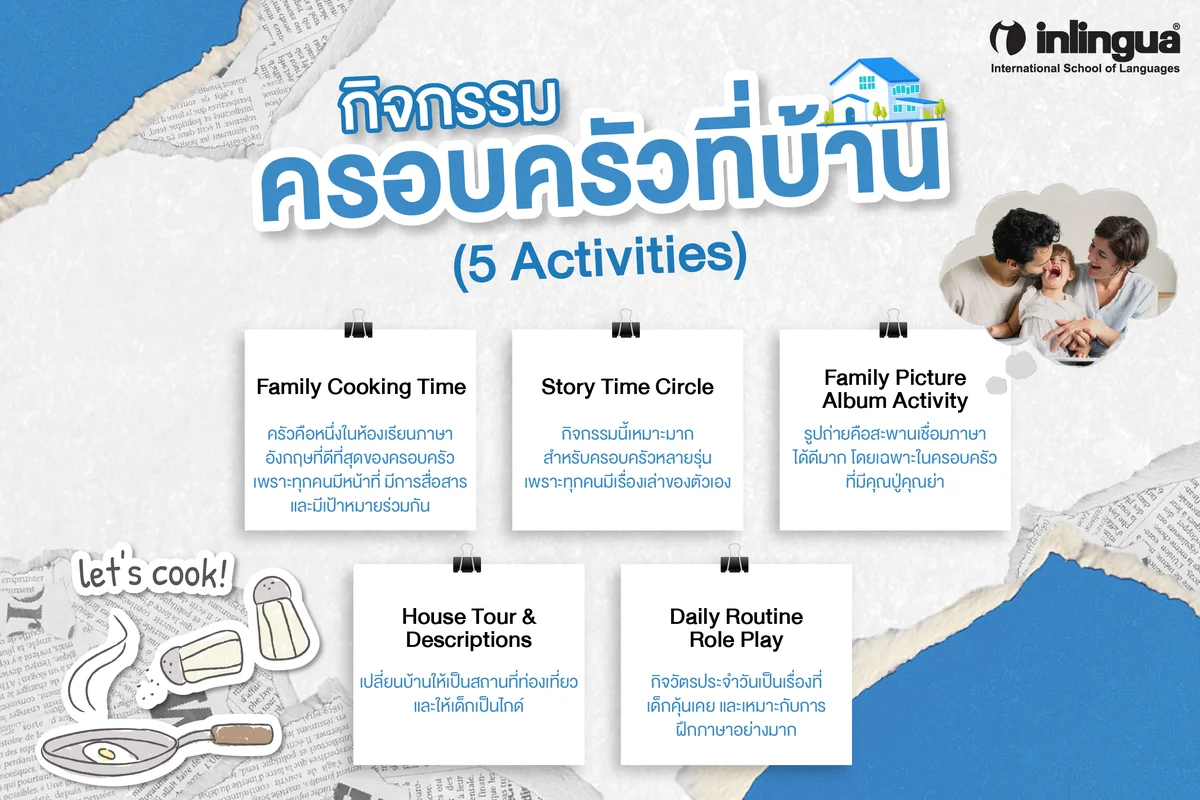
These group activities are designed to be easy, use items you already have at home, and encourage participation from everyone, regardless of their English proficiency. You don't need to do all the activities; choose only those that are suitable for your home and family time.
1. Family Cooking Time
The kitchen is one of the best English language classrooms for families because everyone has responsibilities, communicates, and shares common goals.
Vocabulary and language learned.
- Ingredients: flour, sugar, eggs, milk
- Verbs: mix, stir, pour, cut, bake
- Measurements: cup, spoon, teaspoon
- Temperature: hot, warm, cold
method
Choose simple options like pancakes, scrambled eggs, or salad.
Then, assign roles to everyone.
- Grandma helped me measure.
- Parents help cook.
- The child helps out or arranges the plate.
While doing it, just say simple sentences like...
“Please pass me the sugar.”
“"Let's mix together."”
You don't have to get every word right, just make sure English happens in the kitchen.
Read more: Healthy food in English: Eat well, learn the language, grow up strong. Here are some food and nutrition terms that you can use right in the kitchen.
2. Story Time Circle
This activity is perfect for multi-generational families because everyone has their own story to tell.
method
Sit in a circle and work together to create a story, sentence by sentence.
- Grandpa began: “Once upon a time…”
- Parents continued: “He lived in a small house.”
- The child continued: “One day, he met a dog.”
It doesn't have to be grammatically perfect. It's okay if it's funny, weird, or a little crazy. Fun is the key to this activity.
The result
- The children heard the sentence structures repeated.
- The adults tried speaking without pressure.
- Everyone laughed and relaxed.
3. Family Picture Album Activity
Photographs are a great bridge to language, especially in families with grandparents.
Vocabulary learned
- Family members: grandpa, grandma, uncle, aunt
- Description: young, old, tall, funny
- Past tense sentence: “This was taken when…”
method
Open an old photo album and take turns telling stories based on the pictures.
- My grandparents recounted the events.
- Parents help to expand vocabulary.
- Children ask simple questions such as:
“Who is this?”
“Where was this?”
This activity helps children learn the language while also gaining a better understanding of their family roots.
4. House Tour & Descriptions
Transform your home into a tourist attraction and let the kids be your guides.
Vocabulary learned
- Rooms: living room, bedroom, kitchen
- Furniture: sofa, table, bed
- Activities: cook, sleep, eat, watch TV
method
Have the child lead everyone around the house and say something simple like...
“This is the kitchen.”
“We eat here.”
Adults don't need to correct mistakes; they just need to listen and gently add the correct words.
5. Daily Routine Role Play
Daily routines are familiar to children and are excellent for language practice.
Vocabulary learned
- wake up, brush teeth, eat breakfast
- in the morning, at night, before, after
method
Switch roles and act out daily routines.
- Grandma is playing the role of a child.
- Children are playing adults.
The humor from role-switching helps reduce tension and encourages everyone to speak more freely.
These five activities don't take much time, but they help English gradually and naturally integrate into family life.
Family activities outside the home (5 Activities)
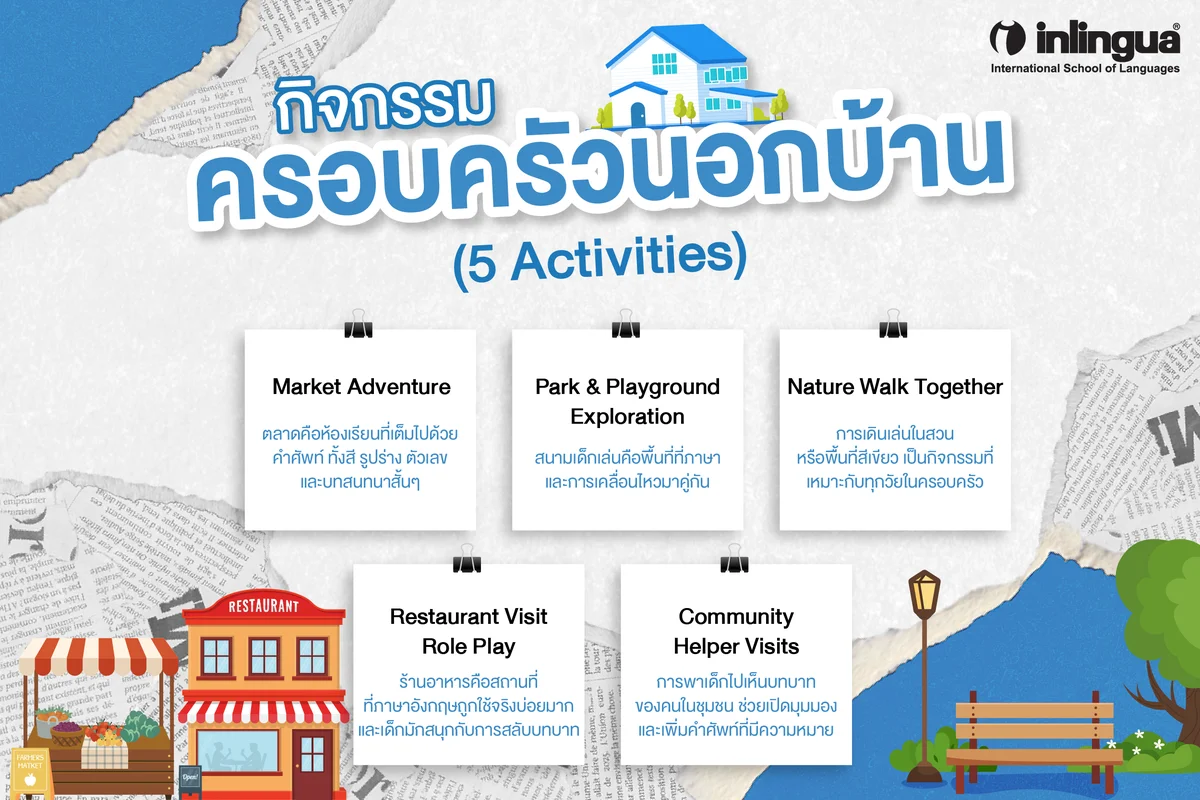
The world outside the home is where English comes to life. Children will see that language isn't just in books, but is used to communicate, solve problems, and connect with those around them. This group activity is perfect for holidays or family outings.
6. Market Adventure
The market is a classroom full of vocabulary: colors, shapes, numbers, and short conversations.
Vocabulary and language learned.
- Fruits and vegetables: apple, banana, carrot, tomato
- Numbers and prices
- Simple sentences:
“How much is this?”
“I want this one.”
method
Go to the market together as a family. Let the children ask simple questions, and adults can add supporting details when needed.
Grandparents might help count the money, parents can explain, and the child gets to practice speaking in real-life situations.
English will no longer be scary when children use it to communicate in real life.
7. Park & Playground Exploration
The playground is a space where language and movement go hand in hand.
Vocabulary learned
- Playground equipment: swing, slide, seesaw
- Verbs: run, climb, jump, push
- Warning: careful, watch out, slowly
method
While the children are playing, the adults help describe what they see.
- “He is climbing.”
- “She is running fast.”
Children begin to associate actions with language without feeling like they are learning. This principle aligns with...Learning English through movement.It helps children memorize vocabulary better through body language.
8. Nature Walk Together
Taking a stroll in a park or green space is an activity suitable for all ages in the family.
Vocabulary learned
- tree, flower, bird, sky, cloud
- Color and description
- Simple sentences: “I see…” “Look at…”
method
Walk together and take turns telling each other what you see.
Your grandmother might say...
“I see a yellow flower.”
The child might answer.
“I see a big tree.”
Just a short explanation is enough; no need for a lengthy explanation.
See more: 100 Nature, Outdoor, and Exploration Vocabulary WordsHere are some words to use when taking a walk with your family.
9. Restaurant Visit Role Play
Restaurants are places where English is actually used very often, and children often enjoy role-playing.
Vocabulary learned
- menu, drink, dessert
- Food ordering phrases:
“I would like…”
“Can I have…?”
method
You can go to a real store or play pretend at home.
Let the children be the employees, grandparents be the customers, and parents help to reinforce the sentences.
This activity helps children become more confident in speaking and understand better communication etiquette.
10. Community Helper Visits
Taking the children to see it.The role of people in the community. It helps broaden perspectives and expand your vocabulary with meaningful words.
Vocabulary learned
- Occupations: doctor, teacher, police officer
- Workplace
- A simple question:
“What do you do?”
“How do you help people?”
method
Go to the library, school, or public place and encourage children to observe and ask questions.
Grandparents are often good at sparking conversation because they are familiar with talking to other people.
These five activities help children see that English is not just a subject, but a real-life skill, and importantly, it allows everyone in the family to participate, regardless of age.
Holiday and Celebration Activities (5 Activities)
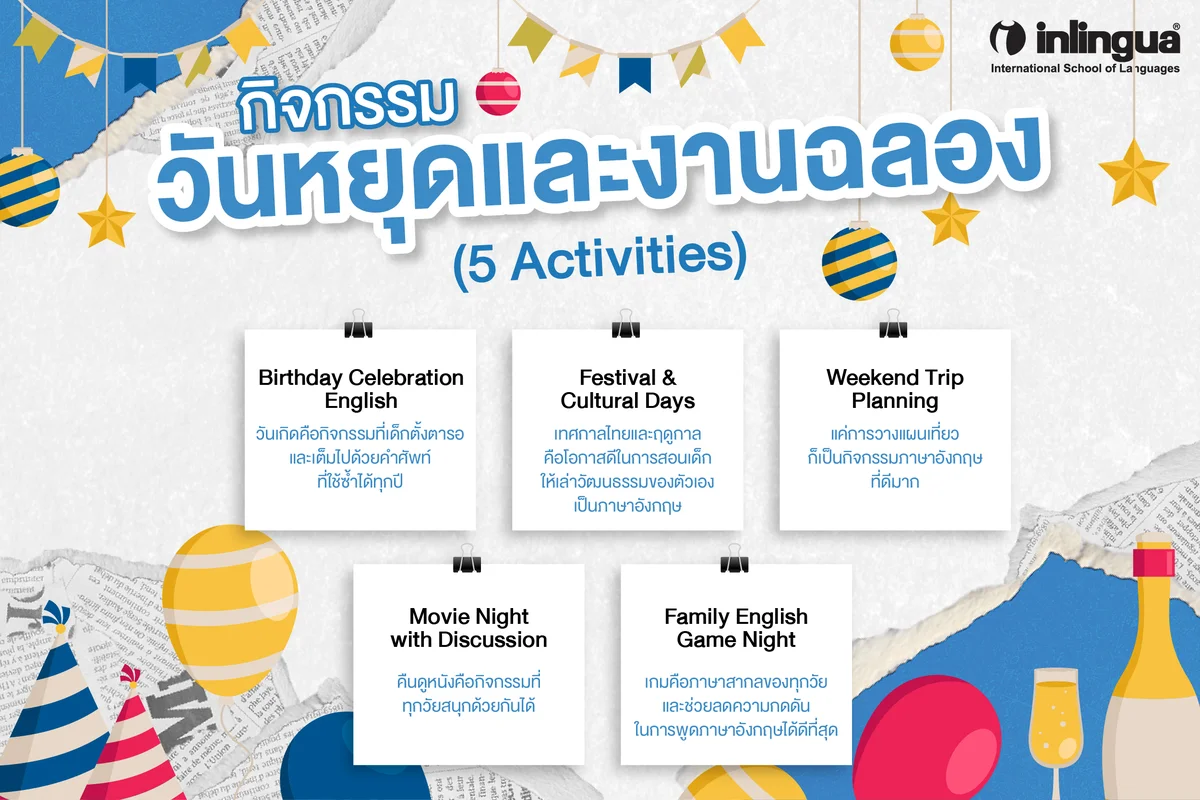
Holidays, birthdays, and festivals are times when families get together the most, and they are excellent opportunities to make English a part of everyone's cherished memories.
11. Birthday Celebration English
Birthdays are an event that children look forward to, and they are full of vocabulary that is used repeatedly every year.
Vocabulary and language learned.
- cake, candle, present, wish
- sing, blow, open, share
- Birthday wishes: “Happy birthday!”
method
Organize a birthday party that blends Thai and English styles. Sing Happy Birthday together and then encourage the children to say simple phrases such as...
“I wish for a toy.”
“I am happy.”
Grandparents can offer blessings, parents can add their own phrases, and children will feel that English is a part of this special moment.
12. Festival & Cultural Days
Thai Festivals and SeasonsThis is a great opportunity to teach children how to describe their own culture in English.
Vocabulary learned
- Songkran, Loy Krathong, New Year
- water, candle, river, celebration
- Verbs: splash, float, count down
method
During the activity, encourage the children to explain in simple English.
- “This is Songkran.”
- “We splash water.”
Grandparents help explain the meaning, parents help structure the story, and children practice telling true stories from their own lives.
13. Weekend Trip Planning
Simply planning a trip is a great way to practice your English.
Vocabulary learned
- pack, drive, arrive, hotel
- Let's go, we should bring...
- places and activities
method
Let's all help plan where we want to go and what we want to do.Use travel as an opportunity to practice transportation vocabulary.Let's go together.
- My grandparents recommended the place.
- Parents helped organize the details.
- The child said what they wanted to do.
English became a tool for collaborative decision-making.
14. Movie Night with Discussion
Movie night is an activity that people of all ages can enjoy together.
Vocabulary learned
- character, story, favorite
- I like…, I don't like…
- It is funny / sad / exciting
method
Choose an English movie or cartoon and turn on Thai subtitles; it's not a problem.
After watching it, start a simple conversation.
- “Who is your favorite character?”
- “What do you like?”
You don't need a long answer; simply speaking it out loud counts as using the language.
15. Family English Game Night
Games are a universal language for all ages and are the best way to reduce the pressure of speaking English.
Vocabulary learned
- Your turn, my turn
- roll the dice, move forward
- win, lose
Suitable game
- Charades (Demonstrating actions for guessing)
- Pictionary (drawing)
- Bingo! Simple vocabulary.
- A board game with simple rules.
method
Everyone plays equally; the focus isn't on winning or losing, but on talking, laughing, and participating. Try using a theme.Animal worldIn the game Charades, children will have fun acting out animal poses and learning vocabulary at the same time.
Tips for Thai families
You don't need to be fluent in English to start.
Many families get stuck with the excuse, "We're not good at English," but the truth is, children don't need a teacher; they need someone who "dares to try with them." The more adults dare to speak, the more children will dare to speak.
You can switch between Thai and English without any problems.
There's no need to speak English (100%). Switching languages is normal.
Today you might say just one word, tomorrow it could be a whole sentence. Consistency is more important than perfection.
How inlingua Supports Family Learning
The family-based language learning concept aligns with inlingua's approach, which emphasizes language use in real-life contexts and collaborative learning.
- There are activities in which parents can participate.
- There are suggestions for parents to continue the activities at home.
- Understanding the context of multi-generational Thai families living together.
The goal is not just to help children speak fluently, but to make the whole family feel good about English. See details.English language courses for childrenDesigned to encourage parental involvement.
Next Steps for Families
If you want to get started, you don't need to do everything at once.
- Choose two or three activities that the family enjoys.
- Set aside small periods of time, such as "Family English Time," once a week.
- Do it consistently and enjoy the process.
When English becomes a part of their lives, children will become more confident without being rushed.
If you want your child's English learning to build upon home-based activities and progress to a more structured and age-appropriate learning environment, inlingua offers easy-to-start English programs for children.
- Language level assessmentAccording to CEFR standards.
- Advice tailored to your child.
- And trial learning.
👉 See details at https://www.inlinguabangkok.com/courses/english-young-learner/
Let English be a subject where the whole family grows together 💛