
In emergencies, small seconds can make a big difference. Some children know they are in danger but are unable to tell or ask for help in English, especially when in unfamiliar places or with people who don't speak Thai.
Therefore, safety vocabulary and phrases are not just "additional knowledge," but life skills that can actually help protect our children. Children don't need to speak English fluently like adults; knowing just a few key words and phrases is enough to communicate their needs, ask for help, or avoid danger.
This article compiles essential English safety vocabulary for children, ranging from basic warnings and everyday safety rules to practical emergency phrases for important situations. The goal is not to fear the outside world, but to prepare children to be aware and confident in taking care of themselves.
at inlingua We prioritize teaching English alongside life skills. Children don't just learn vocabulary; they practice using the language in simulated real-life situations so that when the time comes, they can speak automatically.
Learning about safety through the English language is therefore part of...Building a foundation for children to explore the world.Confident and secure.
Why do children need to know safety vocabulary?
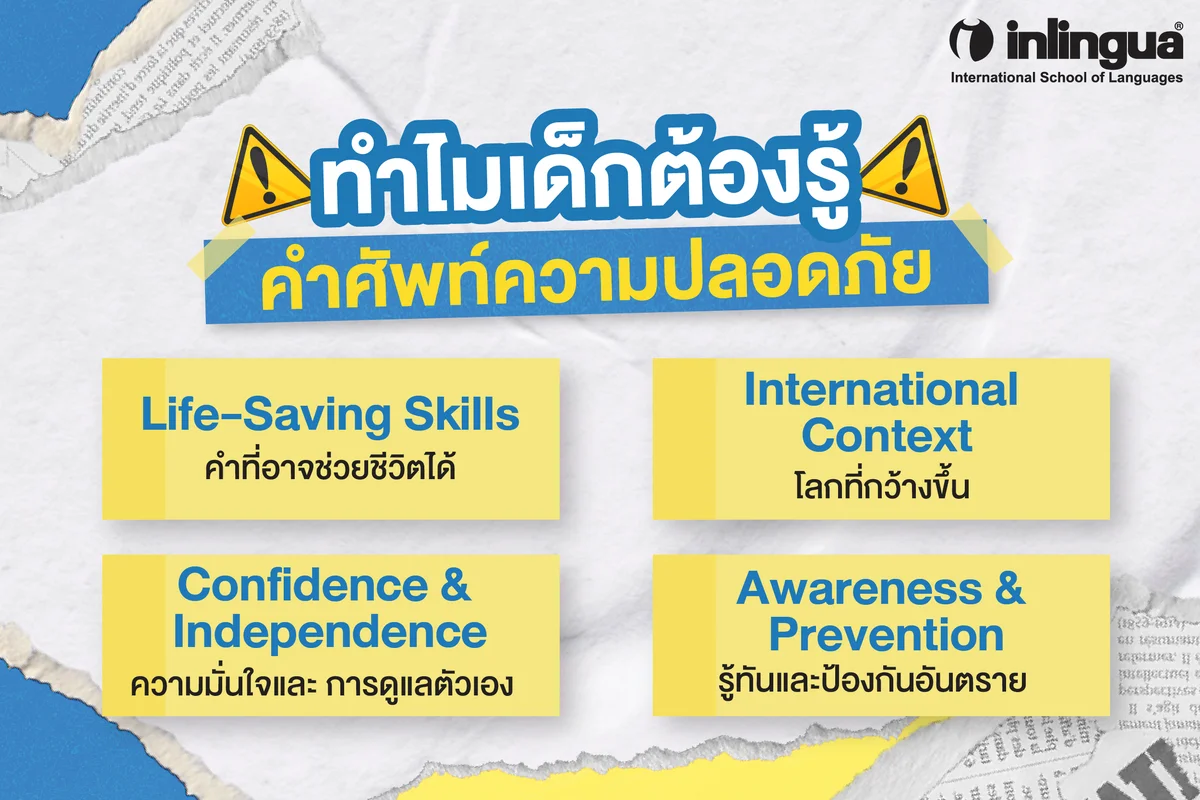
Safety vocabulary isn't just ordinary words like colors or animals; it relates to real-life, unexpected situations. When children "know what to say" at crucial moments, it reduces panic and increases the chances of receiving appropriate help.
Teaching English for safety purposes is not about instilling fear, but about preparing children to use it. life skills Along with confidence in the language.
Life-Saving Skills (Words that could save a life)
In emergency situations, children may not have time to think of long sentences. Knowing simple but essential words like "Help!" or "Stop!" can make a big difference. When children are familiar with emergency vocabulary and phrases, they won't hesitate about what to say but can communicate immediately. English in this context therefore serves as a safety tool, not just a language for learning.
Confidence & Independence (Self-confidence and self-care)
Children who know safety vocabulary will be more confident in facing new situations. They begin to understand what to do and who to talk to if they get lost, get hurt, or feel unsafe.
This confidence helps children become more self-reliant without feeling afraid or confused. Therefore, English is an integral part of fostering age-appropriate independence.
International Context (the wider world)
In today's world, children may have opportunities to travel, visit, or be in environments with foreigners. Knowing English safety vocabulary and phrases can help children communicate with officials or adults who don't speak Thai. Even short sentences can help children describe their situation and receive assistance more quickly.
Awareness & Prevention (Be Aware and Prevent Dangers)
Knowing safety vocabulary helps children notice warnings and danger signs around them. Children will begin to understand what to avoid, what not to do, and what to be careful of.Learn these words early on. Children will become more cautious and able to prevent accidents before they actually happen.
Basic Safety Words
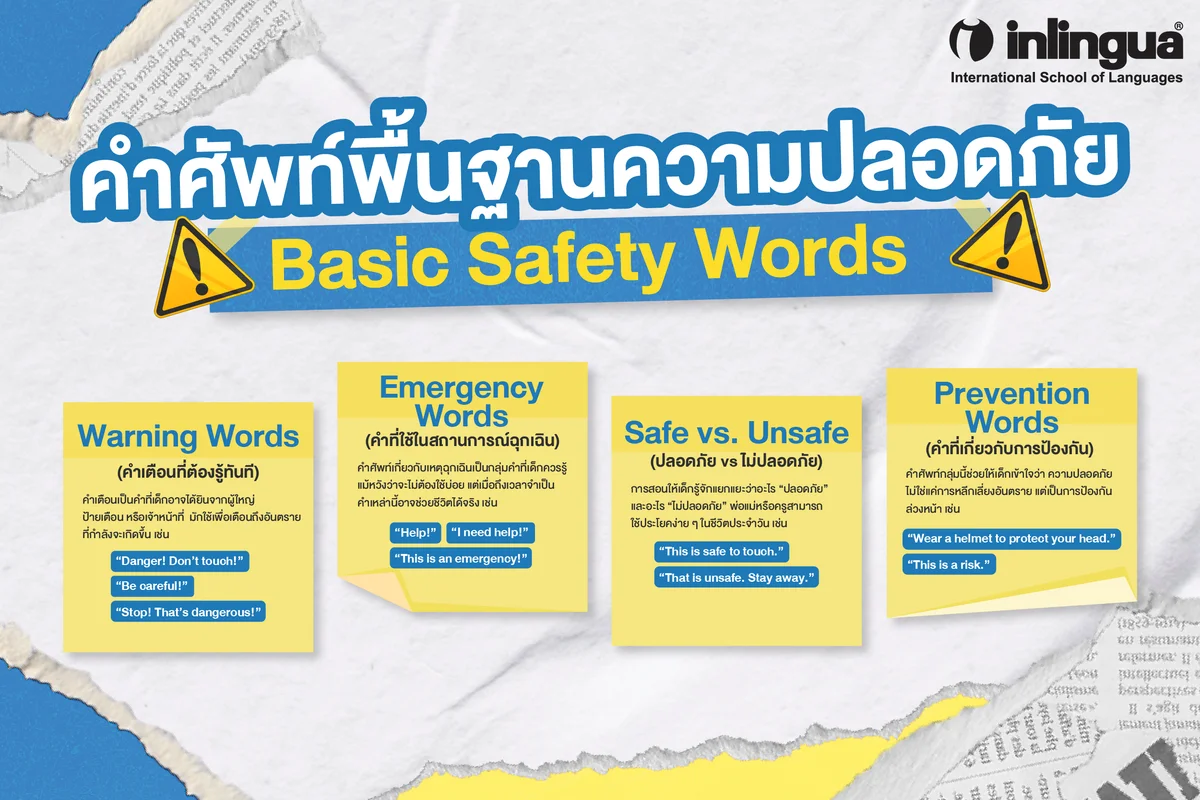
The first group of safety vocabulary words children should learn are those that are "short but powerful," because they are used in crucial moments. Children don't need to understand complex sentence structures; knowing the meaning and when to use them is enough.
Starting with these basic words helps children gradually become familiar with and confidently use English in safety-related situations.
Warning Words (Warnings you need to know immediately)
Warning words are terms children may hear from adults, warning signs, or officials. These words are often used to stop behavior or warn of impending danger.
Words like danger, dangerous, warning, careful, and stop It's a word that should be taught to children from an early age because it's commonly encountered in real life. Children may hear short phrases like...
“"Danger! Don't touch!"”
“Be careful!”
“"Stop! That's dangerous!"”
Once children understand the meaning of these words, they will begin to respond to warnings more quickly and reduce the risk of accidents around them.
Emergency Words
Emergency vocabulary is a group of words children should know. While they may not need to use them often, these words could actually save lives when necessary.
Words like emergency, urgent, and help These are words that children should be able to say without thinking too long. Simple sentences like...
“"Help!"”
“I need help!”
“This is an emergency!”
Teaching children to say these words loudly and clearly helps them avoid being afraid to ask for help when they feel unsafe.
Safe vs. Unsafe
Teaching children to distinguish between what is “safe” and what is “unsafe” is fundamental to preventing harm. Children don't need to know every detail, but they should know the words. safe and unsafe
Parents or teachers can use simple everyday sentences such as:
“This is safe to touch.”
“That is unsafe. Stay away.”
When children begin to use these words, they start to think before they act and are more likely to speak up to warn themselves or others when they see something that might be dangerous.
Prevention Words
This group of words helps children understand that safety is not just about avoiding danger, but about taking preventative measures. Words like... protect, prevent, risk, and hazard Often used in conjunction with everyday safety rules.
Simple sentences that can be used include:
“Wear a helmet to protect your head.”
“This is a risk.”
These words help children begin to understand the reasoning behind the rules and see that safety rules are there to help them take care of themselves, not to restrict their freedom.
Home Safety
Home is where children spend the most time, and many people assume it's "already safe." However, in reality, many childhood accidents occur at home. Teaching English for home safety is therefore a crucial first step, as children can apply it immediately in their daily lives.
Using short English sentences throughout the day helps children remember safety rules without feeling like they're being taught.
Inside the House
Many household items may seem harmless to adults, but are dangerous for children, such as sharp objects, medicine, or chemicals. Learning vocabulary and warning phrases helps children understand that some things are "not toys."“
Practical sentences for everyday life, such as:
“Don't touch.”
“"That's dangerous."”
“Ask an adult first.”
When children hear these sentences repeatedly, along with real-life situations, they begin to learn to stop and think before acting, which is... life skills Very important.
Electrical Safety
Electrical plugs, wires, and appliances are things children see every day, but they shouldn't touch them. Teaching basic vocabulary about electricity helps children understand why they need to be careful.
Common phrases parents use include:
“Don't touch the plug.”
“Electricity is dangerous.”
“Keep your hands dry.”
Giving short, clear warnings in English helps children connect vocabulary to real dangers, not just vague prohibitions.
Fire and heat safety
Fire and hot objects are dangers that children should be aware of from a young age, whether it's a gas stove, hot water, or freshly cooked food. Using English helps children understand and respond more quickly.
Practical sentences such as:
“"Hot! Don't touch."”
“"Fire is dangerous."”
“Stay away from the stove.”
When children hear these warnings frequently, they will begin to remember and avoid risky situations on their own.
Kitchen Safety
The kitchen is the area in the house where accidents are most likely to occur. Teaching safety rules in English helps children engage but also understands the limits.
Examples of useful sentences include:
“Don't touch the knife.”
“The stove is hot.”
“Ask an adult for help.”
Instead of keeping children out of the kitchen, using English to define boundaries helps them learn to be cautious and know how to ask for help appropriately. Once children learn about kitchen safety, this can be further expanded upon.Food and Nutrition VocabularyIt helps children cook simple meals in a fun and safe way.
Bathroom Safety
Wet floors and hot water are common hazards in the bathroom. Children should learn vocabulary and warning phrases related to slips and falls and heat.
Practical sentences such as:
“Be careful. The floor is wet.”
“Don't run.”
“The water is hot.”
Using English in this situation helps children connect vocabulary with immediate actions and reduces the risk of accidents.
Stair Safety
Stairs are another place to be careful. Children often rush or play without realizing it. Using short English phrases can help warn children in time.
Commonly used phrases include:
“Hold the handrail.”
“Don't run on the stairs.”
“Watch your step.”
When these warnings are repeated in daily life, they will become a habit and can truly help prevent accidents.
Road Safety
The road is an area where children are exposed to more risks than at home, and these risks often occur quickly. Knowing English vocabulary and phrases for road safety helps children stop, think, and make better decisions, especially in situations involving cars, people, and noise around them.
Learning English in this context isn't about rote memorization, but about developing practical, everyday awareness habits.
Crossing the Street
Crossing the road is a basic situation that children do frequently. Children should know vocabulary related to roads, traffic lights, and crosswalks in order to understand warnings and signs around them.
Practical sentences that should be practiced repeatedly include:
“Stop.”
“Look left, look right.”
“Wait for the green light.”
“Cross at the crosswalk.”
Speaking these sentences while performing actual actions. It helps children connect language with decision-making and reduces the risk of accidents.
Traffic signals and signs
Traffic lights are something children see every day, but not all of them understand what they mean. Using English helps children remember them more clearly.
Examples of sentences used to teach children include:
“Red means stop.”
“"Green means go."”
“"Yellow means slow down."”
When children understand the meaning of colors and signals, they will become more cautious, even in situations where adults are not nearby.
Car Safety
Car rides are a common activity for children, and those who are familiar with them...Travel and transportation terminologyUnderstanding your surroundings better also carries risks if you don't follow safety rules. Using short English phrases while on the bus helps reinforce correct behavior.
Practical sentences such as:
“Wear your seat belt.”
“Sit in the back seat.”
“Don't distract the driver.”
Repeating the same phrases every time they get on the bus helps children internalize safety rules until it becomes a habit.
Bicycle Safety
Cycling is a fun activity for children, but it also requires caution. Teaching vocabulary related to protective gear and riding rules helps children understand that safety is part of the fun.
Practical sentences such as:
“Wear a helmet.”
“"Watch out for cars."”
“Use your brakes.”
When children understand that protection helps them play safely, they will willingly follow the rules without feeling forced.
Sidewalk Safety
Although walking on the sidewalk may seem safer, children still need to be cautious, especially in areas with vehicle traffic.
Simple reminder phrases that can be used every day, such as:
“Walk on the sidewalk.”
“Stay close to me.”
“Watch where you're going.”
In this context, English helps children become more aware of their surroundings and travel more safely.
Water Safety
Water is something children love, but it's also one of the biggest causes of serious accidents if they don't know how to be careful. Teaching English for water safety is therefore crucial, as it helps children understand warnings and rules and how to ask for help immediately in unexpected situations.
This topic is not about making children afraid of water, but about teaching them to enjoy water safely and responsibly.
At the swimming pool (Pool Safety)
Swimming pools are common places for children, whether at home, in hotels, or at school. Children should learn about them.Basic safety terminology and rules.Before entering the water every time.
Practical sentences that should be practiced repeatedly include:
“Never swim alone.”
“Wait for an adult.”
“Don't run.”
“The water is deep.”
Using these short sentences along with pointing out real-world areas, such as shallow and deep zones, helps children better understand and remember the rules.
The Role of the Caregiver (Lifeguard & Adult Supervision)
Children should know who is in charge of safety and whose instructions they should follow when near water. Knowing vocabulary such as... lifeguard and adult Help children ask the right person for help.
Phrases that children should know, such as:
“Where is the lifeguard?”
“I need help.”
“I can't swim.”
The English language section helps children feel more comfortable asking for help when they feel unsafe.
Life-saving equipment (Safety Equipment)
Equipment such as life jackets or buoyancy aids help increase the safety of children, especially those who are not yet proficient swimmers.
Practical sentences such as:
“Wear a life jacket.”
“Put this on.”
“This helps you float.”
Explaining what these devices do, rather than simply forcing children to wear them, will help them accept and use them more willingly.
Beach and Ocean Safety
The sea is a constantly changing environment. Children should learn vocabulary related to waves, currents, and warning flags to understand unseen dangers.
Practical warning phrases include:
“Stay close to the shore.”
“The waves are strong.”
“Don't go too far.”
When children begin to understand these warnings, they will be more cautious and can enjoy the sea safely. Children who love nature can learn more with...100 Outdoor Nature Vocabulary WordsTo understand the environment around us and to be mindful of nature.
Learn about warning flags and signs.
Warning flags are important signals that children should know. Even if they don't understand all the details, they should know that when they see a red flag or warning sign, they must stop and ask an adult first.
Simple sentences that can be used include:
“Red flag means danger.”
“Ask an adult first.”
The English in this section helps children read their surroundings and make better decisions.
Safety with Strangers (Stranger Danger)
One of the most important life skills for children is knowing "who a stranger is" and what to do when feeling unsafe. Teaching English on this topic is not to instill fear of others, but to help children set boundaries and protect themselves appropriately.
English for safety in this situation helps children confidently say no, ask for help, and communicate with trusted adults.
Getting to know strangers (Stranger Awareness)
Children need to understand that strangers are people we don't know, even if they seem kind or speak nicely. Knowing basic vocabulary helps children better distinguish between these situations.
Simple sentences used to teach children, such as:
“I don't know you.”
“You are a stranger.”
“I need to ask my parents first.”
Once children become familiar with these phrases, they will be more willing to say no without feeling guilty or afraid.
Who are the safe adults?
Children don't need to be afraid of everyone, but they should know who are adults they can ask for help from, such as... Police officers, firefighters, or officers in uniform.
Practical sentences such as:
“Where is the police officer?”
“I'm lost.”
“Can you help me?”
Training children to seek out a suitable adult helps them make better decisions in unfamiliar situations.
Things you shouldn't accept or do (What Not to Do)
Children should learn not to accept gifts or go anywhere with strangers, even if they seem appealing, such as candy or toys.
Phrases that children should know, such as:
“"No, thank you."”
“I don't take things from strangers.”
“I need to ask my mom or dad.”
The English in this section helps children set boundaries politely but clearly.
Personal information you shouldn't share (Personal Information Safety)
Another important skill is disclosing personal information. Children should know that some information is private and should not be shared with strangers.
Examples of useful sentences include:
“I can't tell you.”
“"That's private."”
Teaching children to speak like this helps them defend themselves without needing lengthy explanations.
What should you do if you feel unsafe? (What to Do if Approached)
Children should have a plan in mind when they feel unsafe, whether it's speaking up, running to a safe place, or telling an adult immediately.
Important sentences to practice include:
“"No!"”
“"Help!"”
“"Stop!"”
Practicing saying these words aloud and clearly helps children avoid hesitation when a real emergency occurs and increases their chances of receiving help.
Asking for Help
Even if children are good at avoiding danger, equally important is "knowing how to ask for help." Teaching English on this topic helps children not to be silent, hesitant, or try to cope with difficult situations alone.
The goal is not for children to memorize long sentences, but for them to have simple words in their vocabulary that they can say immediately when needed.
Basic Help Phrases
These words and phrases should be among the first things children say automatically, as they can be used in almost any situation where they feel unsafe.
Sentences that should be practiced frequently include:
“"Help!"”
“Please help me!”
“I need help.”
Training children to speak loudly and clearly increases the chances that those around them will notice and help them more quickly.
When a Child Is Lost
Getting lost is a common situation. Children should know what to say and who to seek help from first.
Phrases that children should know, such as:
“I'm lost.”
“I can't find my mom.”
“Can you help me?”
Practicing these phrases helps children avoid panicking and allows them to confidently communicate with a safe adult.
In case of illness or injury (Medical Emergencies)
When injured or ill, children should know how to describe their symptoms or ask for help as quickly as possible. The English in this section helps children communicate in such situations even when with people who don't speak Thai.
Practical sentences such as:
“I'm hurt.”
“My friend is hurt.”
“I need a doctor.”
“Call an ambulance.”
Even though it's a short sentence, it can help adults understand the situation immediately.
Emergency Numbers
Children should know when to use emergency numbers, and that they are not toys. Teaching should involve explaining the situation, not just memorizing numbers.
Examples of speech practice include:
“This is an emergency.”
“I need help at…”
For children in Thailand, it is important to teach them important numbers such as:
- policeman
- ambulance
- Firefighting
Ready to practice giving simple location information, such as place names or nearby landmarks.
Important Personal Information that Children Should Know
In some situations, children may need to provide personal information to help adults provide accurate assistance. Practicing providing this information in English helps children be better prepared to handle such situations.
Basic information that should be practiced includes:
- Name-Surname
- Parents' names
- telephone number
- Address or name of a place near your home.
Simple sentences like:
“My name is…”
“My mom's name is…”
“My phone number is…”
Regular practice helps children remember things even in exciting situations.
School Safety
School is where children spend almost half their day. They may automatically think it's a safe space, but in reality, school involves friends, teachers, activities, and unexpected situations that can always occur. Learning English for school safety helps children understand instructions, remind themselves of rules, and follow regulations correctly.
English in this context isn't used for exams, but rather for "listening to understand and doing it correctly" in real-life situations.
Fire drill
Fire drills are something many children have done, but not all of them understand the instructions the teacher gives in English. Knowing basic vocabulary and phrases helps children avoid panic and follow the procedures safely.
Phrases that children should be familiar with include:
“Line up.”
“Walk, don't run.”
“Stay calm.”
“Follow the teacher.”
Once children understand these instructions, fire drills will no longer be frightening, but rather a valuable life skill training exercise.
Moving Safely as a Group
At school, children often walk in groups, whether to the playground, the cafeteria, or out of the building. Teaching simple vocabulary helps children be more careful and prevent accidents.
Practical sentences such as:
“Walk in a line.”
“Don't push.”
“Wait your turn.”
Learning English in this situation can help reduce chaos and cultivate habits of safe movement.
Playground Safety
Playgrounds are where children have the most fun, but they are also places where accidents are easily caused. Learning vocabulary and warning phrases helps children play more carefully.
Practical sentences such as:
“Be careful.”
“Hold on tight.”
“Don't push.”
“Wait for your turn.”
When children understand that fun must come with safety, they will begin to take better care of themselves and their friends.
Managing Minor Accidents at School
Children may fall, bump into things, or get scrapes during the day. Knowing how to describe these injuries in English can help teachers provide immediate assistance.
Phrases that children should know, such as:
“I fell.”
“I'm hurt.”
“It hurts here.”
Practicing these sentences helps children not to keep their feelings to themselves and to receive appropriate care.
Telling a Teacher or Adult
Children should know who to tell first if something happens. Knowing vocabulary related to teachers and caregivers helps children ask for help quickly.
Simple, practical sentences such as:
“"Teacher, I need help."”
“There is a problem.”
“My friend is hurt.”
The English in this section helps children overcome hesitation and understand that asking for help is not wrong.
Basic First Aid
Minor accidents can happen all the time in daily life. Children might fall, get cut, or get bitten by insects. While not serious, if children know how to describe their symptoms and what to do first, it will help adults get help more quickly and reduce the child's panic.
Teaching English on this topic is not aimed at making children nurses, but rather to helping them... Communicate symptoms clearly. And they know to tell an adult immediately when something happens.
Minor injuries (Common Injuries)
Children often get scrapes, cuts, or bruises while playing. Knowing simple vocabulary and sentences can help children describe what has happened.
Practical sentences such as:
“I'm hurt.”
“I fell down.”
“It hurts.”
“There is blood.”
When children can speak, adults understand the situation more quickly and can provide more targeted care.
Describing the location of pain.
Children don't need to explain in detail; simply stating the location is enough. The English in this section helps children communicate more clearly.
Simple sentences that can be practiced, such as:
“It hurts here.”
“My arm hurts.”
“"My knee hurts."”
Practicing speech therapy with pointing to locations helps prevent confusion and reduces stress in the event of accidents.
Fire and Hot Objects
Hot objects are a potential hazard for children at both home and school. Children should learn to tell immediately if they get scalded or feel a burning sensation.
Phrases you should know include:
“It's hot.”
“I got burned.”
“It hurts a lot.”
English in this situation helps adults know when to help quickly and not to overlook the child's symptoms.
Insect Bites & Stings
Insect bites are common, and children should know how to describe symptoms such as itching, swelling, or pain so that adults can provide proper care.
Practical sentences such as:
“It's itchy.”
“I was bitten.”
“It's swollen.”
Teaching babies to speak instead of scratching or crying helps them communicate their feelings better. Babies who know how to speak…Animal and insect vocabularyThis will allow them to describe what type of insect bit them, helping adults provide more targeted care.
What children should do first.
In all cases, the most important thing is for the child to tell an adult immediately. Children should not try to manage the situation themselves or hide their symptoms.
Sentences that should be practiced habitually include:
“Tell a teacher.”
“Tell an adult.”
“I need help.”
When children understand that asking for help is the right thing to do, they will be less hesitant and feel more secure in receiving care.
Simulation training (Safety Role Play)
Knowing safety vocabulary or phrases alone may not be enough. More importantly, it's about encouraging children to confidently use that language in real-life situations. Simulations or role-playing are therefore the most effective way to teach English for safety.
When children are given the opportunity to speak, act, and make decisions in a safe environment, they are less likely to panic when faced with similar situations in real life.
Activity 1: Emergency Call Practice
This activity helps children become familiar with asking for help over the phone without fear or embarrassment. Children don't need to speak at length; they just need to communicate essential information clearly.
Examples of sentences you can practice with include:
“This is an emergency.”
“My name is…”
“I need help.”
“I am at…”
Regular repetition will help children remember the sequence of speech and know where to start when the situation actually arises.
Activity 2: Lost Child Scenario
The situation of children getting lost is a common occurrence in shopping malls, parks, or tourist attractions. Role-playing helps children develop a plan in their minds and avoid panic.
Sentences you should practice include:
“I'm lost.”
“I can't find my parents.”
“Can you help me?”
This training should be combined with instructions to point out that children should stay where they are and look for a safe adult, such as a staff member or employee.
Activity 3: Fire Safety Practice
Fire drills help children understand basic procedures without fear. Instructions should focus on short commands that children can hear and follow immediately.
Examples of sentences used for practice include:
“Stop.”
“Don't run.”
“Follow the teacher.”
“Go outside.”
When teaching "Stop, Drop, and Roll," it should be practiced with movement so that children learn through body language, not just words. This type of practice is consistent with...Learning a language through body movement.This helps children memorize vocabulary through actual movement, not just by sitting and rote memorization.
Activity 4: Stranger Danger Role Play (Practice saying no to strangers)
Practicing saying "no" clearly is an important skill. Many children hesitate because they don't want to be impolite. Role-playing helps children understand that refusing for safety reasons is not wrong.
Sentences you should practice include:
“"No, thank you."”
“I don't know you.”
“I need to ask my parents.”
“"Help!"”
Training in a safe environment helps children gain confidence and dare to use their voice when needed.
Activity 5: Asking for Help Practice
This activity focuses on practicing speaking with a safe adult, such as a teacher, police officer, or official. Children will learn how to begin a conversation and what to say first.
Simple sentences for practice, such as:
“I need help.”
“My friend is hurt.”
“There is a problem.”
Once children become familiar with saying these sentences, they will be less likely to remain silent or keep their problems to themselves.
How inlingua Teaches Safety
at inlingua We believe that English for Safety It goes beyond simply memorizing vocabulary. Children need to practice using the words in situations similar to real life so that they can respond automatically when unexpected events occur.
Real-Life Scenarios
Safety lessons are designed based on real-life scenarios children might encounter, such as getting lost, getting injured, or being in public places. Children practice using short, practical phrases, not long, difficult-to-remember sentences. This type of learning helps children remain calm and know where to start when an emergency occurs.
Learning by Doing
Children role-play various situations, such as:
- Requesting help
- Rejecting strangers.
- Following emergency orders.
When children speak, move their bodies, and experiment in a safe environment, English becomes a life skill, not just knowledge acquired in the classroom.
Confidence First.
We emphasize encouraging children to speak confidently before speaking correctly. Children are not pressured about grammar, but are encouraged to use language to communicate what is most important. This confidence is the heart of using English safely.
See detailsEnglish language courses for childrenThat teaches both language and life skills at the same time.
Tips for Parents: Teach Home Safety Naturally
Parents don't need to schedule extra tutoring; they can teach English for safety reasons simply by using their regular daily lives.
Use Short, Clear English
Use short, repetitive sentences, such as:
“Be careful.”
“Stop.”
“Ask an adult.”
Using the same words in real-life situations will help children remember them without rote memorization. Parents and family members can subtly incorporate these reminders through...English language activities that the whole family can do together.In daily life
Practice Little and Often
No need for lengthy lessons, just short, regular reviews, such as:
“What would you say if you are lost?”
“What do you say when you need help?”
Frequent practice is better than a one-time lesson. Parents can adapt the training topics as needed.Changing seasons and circumstances. For example, summer training focuses on water safety, while rainy season training focuses on slippery roads.
Don't Teach with Fear
Teach children to know, not to be afraid. A good example is...
“I'm teaching you this to keep you safe.”
Children are more open to learning when they know their parents are teaching them to protect them, not to threaten them.
Praise Awareness
When a child is mindful or speaks up after being warned, praise them immediately. For example:
“Good job being careful.”
“You did the right thing.”
Praise reinforces good behavior and makes children want to repeat it.
Conclusion
English safety vocabulary and phrases are one of the most important skills for children, as they can potentially save lives. Children don't need to be fluent in English, but they need to know the correct words for crucial situations.
When children learn English for safety through real-life situations, they become more confident, learn to recognize dangers, ask for help, and follow rules rationally.
Teaching children about safety from today is the key to preparing them for the future.Explore the world through the English language.In the future, both in terms of language and life skills.
At inlingua, we design English language courses for children with a focus on... Safety + Language + Life Skills Children don't study for exams, but to use the knowledge in real life.
If you want your child...
- Use English with confidence.
- Learn to take care of yourself.
- Ready to handle real-life situations.
See details of our English language courses for children here.
👉 https://www.inlinguabangkok.com/courses/english-young-learner/