
Children see cars, trains, planes, and buses around them almost every day, from going to school to going to the mall to going on trips with their families. But when asked, "What is this called in English?", many children can't answer, even though they are the most familiar things in their daily lives.
Transportation and travel vocabulary is one of the words children should learn from an early age because it's frequently used, linked to real-life experiences, and can be applied immediately, whether talking about everyday vehicles or holiday travel.
This article compiles... 50 English vocabulary words related to travel. Suitable for children, it covers various types of vehicles, travel-related places, and basic phrases commonly used while traveling. The goal is not just for children to memorize vocabulary, but for them to understand and use English from what they see and do in real life.
at inlingua We believe that English language learning for children should begin with the world around them. Travel is a topic that helps children learn through observation, movement, and direct experience, whether it's getting on a bus, waiting for a train, or walking through an airport. When English is connected to travel, children feel that language isn't just confined to the classroom, but is a tool that helps them learn.Gain understanding of the wider world through exploration. And ready to embark on their journey with greater confidence.
Why do children need to learn travel vocabulary?
Travel vocabulary is one of the words children are most likely to use in real life because it's directly related to daily life, whether it's taking a bus to school, riding the train, going to the airport, or traveling with family. English in this area is therefore not something distant, but rather language that children "see, use, and hear" constantly.
Daily Relevance (Close to home, used every day)
Children use vehicles regularly, from cars, buses, and trains to walking. Learning transportation vocabulary helps children talk about what's happening around them immediately.
Simple, practical sentences such as:
“We go to school by car.”
“I take the bus.”
“We walk to the park.”
When children can talk about their daily routines in English, they feel that English is not just an exam subject, but a language to tell stories about their own lives.
Future Travel Skills (Preparing for Future Travel)
Travel isn't limited to cities or within the country. Children who are familiar with travel vocabulary from a young age will be better prepared when they have the opportunity to travel far or internationally.
Even basic vocabulary like "train," "airport," or "plane" can help children feel less anxious or confused when encountering new places and begin to communicate confidently.
Expanding Worldview
Learning travel vocabulary helps children understand that people in different countries travel differently. Some use trains, some use boats, and some walk more than they take buses. This concept helps children broaden their perspective and begin to understand the differences in societies, cultures, and lifestyles through something as familiar as travel. Learning that connects with real life.It is an approach that helps young children better understand the world around them through meaningful experiences.
Action & Movement (Learning through movement)
Travel vocabulary is often associated with movement, such as getting on, getting off, walking, driving, or flying. Children can learn these words through play, gestures, or role-playing activities in a fun way. When language is linked to movement, children remember words more easily and use English more naturally. This approach aligns with...Learning a language through physical activity.This helps children memorize vocabulary through body language, not through rote memorization.
Road vehicles
Vehicles on the road are the most frequently seen by children in their daily lives, from cars going to school and buses passing by their homes to special vehicles that often excite them when they see them. Starting to learn transportation vocabulary from this group helps children immediately connect English with their surroundings.
Cars and Private Vehicles
Private cars are the most familiar mode of transportation for children. They can start by naming the cars they use at home or the cars they see on the road.
Basic vocabulary in this group will help children talk about their family trips more easily, such as:
“We go to school by car.”
“My family has a big car.”
“This car is fast.”
When children begin to notice the cars around them, they will enjoy naming the vehicles in English without feeling like they are learning.
Parts of a Car
Learning about the different parts of a car helps children better understand safety warnings and rules, such as when to fasten their seatbelts or get in and out of the car.
Simple, practical sentences such as:
“Sit on the seat.”
“Close the door.”
“Look out the window.”
“Hold the steering wheel.”
This group of words is related to... life skills And naturally, it enhances road safety.
Public Transportation
Public transport is another important topic, as many children use buses, school buses, or shuttle buses. Learning this vocabulary helps children understand the city's transportation system.
Sentences that children hear and use frequently include:
“I take the bus.”
“Wait at the bus stop.”
“Get on the bus.”
Once children understand these words, they will begin to notice the routes, bus stops, and passengers around them more.
Taxi and ride services
Taxis are a common mode of transportation for children in large cities. Knowing basic vocabulary helps children understand simple conversations during their commute.
Practical sentences such as:
“Take a taxi.”
“Please take me home.”
“"How much is it?"”
The English in this section helps children become familiar with communicating while traveling, even if they are not yet native speakers.
Special and service vehicles
Service vehicles, such as ambulances, fire trucks, or police cars, are types of vehicles that children often find interesting. Learning vocabulary related to these vehicles helps children understand the roles of these vehicles in society.
Examples of useful sentences include:
“That is an ambulance.”
“The fire truck is red.”
“Police cars help people.”
This vocabulary is also related to learning about...Occupations that help the community.And the safety is very good.
Water Transportation
Water travel is another experience familiar to Thai children, whether it's taking a ferry, visiting the beach, or seeing boats in canals and rivers. Learning transportation vocabulary in this category helps children naturally connect English with culture and tourism. The sea, canals, and rivers are all part of it.The natural world that children can observe. Knowing aquatic environment vocabulary will help children describe what they see during their travels more clearly.
Vocabulary related to boats and water travel also helps broaden children's perspectives, showing them that in many countries, traveling by boat is as common as driving on the road.
Boats and small vessels
Children are often excited about boats because they are a different type of vehicle than cars. Starting with basic vocabulary helps children talk about their travel experiences more easily.
Practical sentences such as:
“We go by boat.”
“This boat is fast.”
“We ride a boat to the island.”
In the context of Thailand, children can also learn vocabulary related to local culture, such as "long-tail boat," which helps them describe Thai-style transportation in English.
Actions on Water
Water travel often comes with clear verbs such as rowing, sailing, or floating. Children can learn these words through gestures or storytelling.
Simple sentences that can be used include:
“The boat is sailing.”
“We are floating on the water.”
“They are rowing the boat.”
When vocabulary is associated with movement, children remember words more easily and enjoy learning more.
Parts of a Boat
Learning about the basic components of a ship helps children understand descriptions and warnings during voyages.
Practical sentences such as:
“Sit on the deck.”
“Hold the paddle.”
“The boat has a sail.”
This vocabulary also helps children better understand water safety.
Large ships
Large ships, such as cruise ships or cargo ships, are things children may see from travel or the media. Children can learn these words to expand their understanding of long-distance travel.
Examples of useful sentences include:
“That is a big ship.”
“The ship carries many people.”
“We see ships at the port.”
Learning in this section helps children see that water travel isn't just about small boats, but also plays an important role on a global scale.
Ports and Water Travel
Waterways often begin at harbors. Learning vocabulary about places helps children tell more complete travel stories.
Simple sentences like:
“We wait at the port.”
“The boat leaves the dock.”
“We arrive at the island.”
The English language content in this section helps children connect water travel with real-life travel experiences.
Air Transportation
Air travel is an experience that many children find exciting, from seeing planes in the sky to going to the airport with their families. The transportation vocabulary in this section helps children understand what's happening around them and avoids confusion when traveling long distances.
Learning air travel vocabulary is also a way to prepare for international travel, as English is used most frequently in real-life situations.
Airplanes
Airplanes are easily recognizable vehicles for children because of their distinctive shape and sound. Starting with basic vocabulary helps children confidently tell stories about their journeys.
Practical sentences such as:
“We go by plane.”
“The plane is big.”
“The plane is flying.”
When children can talk about traveling by airplane, they begin to associate the English language with fun and exciting memories.
At the airport
Airports are a new place for many children, full of procedures, people, and English signs. Knowing basic vocabulary helps children understand what is happening.
Common phrases children hear include:
“We are at the airport.”
“Let's go to the gate.”
“We wait here.”
Familiarizing children with these terms can reduce anxiety and help them travel with more confidence.
Flight Process
Even though children don't need to understand every step, knowing simple terms related to boarding and disembarking can help them follow the situation.
Practical sentences such as:
“The plane is taking off.”
“We are landing.”
“Please sit down.”
The English in this section helps children understand onboard announcements and follow instructions better.
People involved in aviation (People on a Plane)
Learning about the roles of people on an airplane helps children understand who does what and who to ask for help when needed.
Simple sentences like:
“The pilot flies the plane.”
“The flight attendant helps people.”
“There are many passengers.”
This group of vocabulary words is helpful. life skills And safety during travel.
Other aircraft
Besides airplanes, children may have seen helicopters or hot air balloons. These terms help broaden children's perspectives on air travel.
Examples of useful sentences include:
“That is a helicopter.”
“The balloon is in the sky.”
Learning in this category helps children enjoy observing the world and naturally name the things they see in English.
Rail Transportation
Traveling by train is a familiar experience for many children, especially in large cities where electric trains are an integral part of daily life. Children may use trains to go to school, to the mall, or to travel with their families. Learning transportation vocabulary in this category will therefore help children talk about their own journeys naturally.
Train vocabulary also helps children understand public transportation and learn about waiting, boarding and alighting, and traveling in an orderly manner.
Types of Trains
Trains come in many forms. Children can start with trains they see and use in everyday life, and then gradually expand to trains in other countries.
Practical sentences such as:
“I go by train.”
“I take the sky train.”
“The train is fast.”
Once children can name different types of trains, they will begin to notice the differences in the journey more.
At the train station
Train stations are places with many signs, languages, and people. Knowing basic vocabulary helps children understand which way to go and what to do.
Simple, practical sentences such as:
“We are at the station.”
“Wait on the platform.”
“The train is coming.”
Using these words during real-life travel experiences helps children better connect English with firsthand experiences.
Getting on and off the train.
Boarding and alighting a train requires caution and adherence to rules. Children should learn vocabulary and short phrases used in these situations.
Examples of useful sentences include:
“Get on the train.”
“Get off here.”
“Stand behind the line.”
The English language in this section is related to both... travel and safety Naturally
Changing Trains and Onward Travel
On some routes, children may need to change trains. Knowing simple vocabulary helps children understand that the journey isn't over and what they need to do next.
Practical sentences such as:
“We change trains here.”
“This is the last stop.”
“The next station is…”
When children understand this concept, they will be less confused and be able to follow the family's journey better.
Train Etiquette and Safety
Trains are public spaces. Children should learn to coexist safely and respectfully with others.
Simple warning phrases that can be used include:
“Hold the handrail.”
“Stand still.”
“Please wait.”
Using English in this context helps children understand that a good journey is not just about arriving at your destination, but also about being safe and respecting others.
Travel Destinations and Journey
Once children begin to recognize different types of vehicles, the next step is to connect travel vocabulary with "destinations," because a journey is complete only when the child can describe it. Where to go? and What are you going to do?
This topic helps children use English to tell stories about their real-life travels, whether it's a trip to the beach, the mountains, or a place near home during their holidays.
Airports and Aviation
Airports are where children are exposed to the most English, from signs and announcements to conversations. Knowing basic vocabulary helps children avoid confusion and understand the travel process.
Practical sentences that children can use, such as:
“We are at the airport.”
“Let's go to the gate.”
“We wait here.”
Once children become familiar with these words, they will begin to notice their surroundings and realize that English is truly useful while traveling.
Hotels and Accommodation
Staying at a hotel is an experience that children often find exciting, whether it's the room, the pool, or the breakfast. Learning vocabulary in this category helps children tell more complete stories about their travels.
Simple, practical sentences such as:
“We stay at a hotel.”
“This is our room.”
“The hotel has a swimming pool.”
The English in this section helps children talk about their travel experiences naturally, not just by saying "I went traveling." In addition, travel provides children with opportunities to try new foods and get acquainted with new things.Food and Nutrition VocabularyIt makes sharing stories about meals while traveling much more fun.
Tourist attractions
Tourist attractions are a fun topic for children to talk about, whether it's a zoo, the beach, or the mountains. Knowing basic vocabulary helps children describe what they see and what they do better.
Practical sentences such as:
“We go to the beach.”
“I see animals at the zoo.”
“We take photos.”
Learning vocabulary in this category helps children connect travel with experiences and memories, especially going to the zoo, which children are familiar with.Animal VocabularyYou'll enjoy observing and describing the animals you see in English even more.
Giving directions and getting around.
Asking for and giving directions is an important skill while traveling. Although children may not need to use all of these skills themselves, understanding the vocabulary helps them follow adults.
Examples of sentences you can practice include:
“Go straight.”
“Turn left.”
“Turn right.”
“It's near.”
“It's far.”
The English language section helps develop listening, observation, and spatial thinking skills simultaneously.
Family Travel
Traveling with family is a golden opportunity to practice English in a stress-free environment. Children can share simple stories from their own experiences.
Practical sentences such as:
“We travel together.”
“We go on a trip.”
“I like this place.”
When children use English to tell their own stories, they feel that the language is theirs, not just something in textbooks. Travel is also...Activities that the whole family can enjoy together. Encourage parents or grandparents to practice speaking English with the children along the way.
Transportation Learning Activities
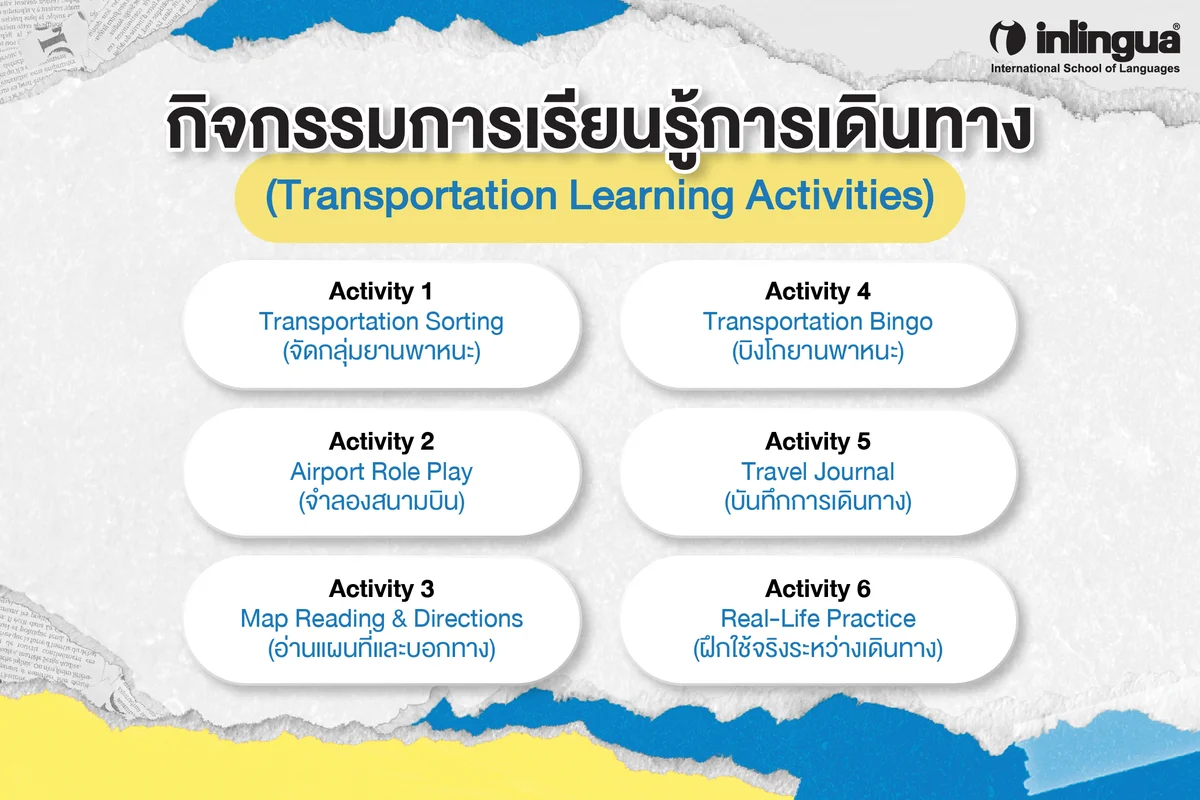
Transportation vocabulary is best learned when children “use” English through movement, observation, and play. Activities related to travel transform vocabulary into experiences, not just rote memorization.
These activities can be done in the classroom, at home, or even while traveling, without the need for complicated equipment.
Activity 1: Transportation Sorting (Grouping Vehicles)
This activity helps children understand different types of transportation and begin to think systematically. Children can use pictures, toys, or simply say the names of vehicles.
Gameplay guidelines:
- Vehicles can be categorized as follows: On land / on water / in the air
- separate Public transport / Private vehicle
- compare Fast / Slow
Sentences used to insert during activities, such as:
“This is a road vehicle.”
“This one goes on water.”
“The plane is fast.”
This activity helps children connect. Transportation Terminology With the ability to think categorically naturally.
Activity 2: Airport Role Play (Simulating an airport)
Airports are places where English is widely spoken. Simulations help children understand the travel process without feeling pressured.
Scenarios suitable for practice:
- Check-in point
- Security checkpoint
- Boarding gate
Examples of sentences used for practice include:
“I want to check in.”
“Here is my ticket.”
“Where is the gate?”
This activity helps children become more confident in using [the tools/products]. Travel English And I understand that English plays a real role in travel.
Activity 3: Map Reading & Directions
Using maps helps develop observation and listening skills. Children can practice giving simple directions without needing to be perfectly precise.
Practical sentences such as:
“Go straight.”
“Turn left.”
“Turn right.”
“It's near.”
This activity helps children understand travel vocabulary related to directions and practice purposeful communication.
Activity 4: Transportation Bingo
Bingo games help children memorize vocabulary without feeling like they're learning. Children have to listen and correctly connect the sounds with the words.
During playtime, a teacher or parent might say:
“I see a bus.”
“Who has a train?”
Children will practice listening and memorization. Vehicles (English) Fun
Activity 5: Travel Journal
Having children share stories about their own travels helps connect English with their memories. Children don't need to write long stories; short sentences are enough.
Examples of storytelling include:
“I go to the beach by car.”
“We take a train.”
“I like the airplane.”
This activity helps develop storytelling skills and makes... travel It has become a continuous source for language learning.
Activity 6: Real-Life Practice (Practical application during travel)
The best way to do this is to use English while actually traveling, for example:
- Name the vehicle you see.
- Ask the child, “How do we go there?”
- Have the child say, "We go by bus."“
Learning English in real-life situations is the best way for children to stick with it, because they immediately see how useful the language is. Learning through direct experience and play.It's a way to help make English a part of children's lives, not just a subject in the classroom.
Common travel phrases and expressions.
Once children have vocabulary related to transportation and travel, the next important step is to put those words together into sentences for real-life communication. These travel phrases are ones children hear frequently, can be used repeatedly in many situations, and are excellent for practicing everyday conversation.
Asking for Directions
Asking for directions is a basic skill children should be familiar with. Even if they don't use all the phrases themselves, understanding these sentences helps children follow adults and prevents them from panicking when lost.
Commonly used phrases include:
“Excuse me, where is the bathroom?”
“Where is the bus stop?”
“How do I get to the museum?”
“"Is it far from here?"”
Parents can practice by pointing to places around them and letting the child ask questions in English in a playful way.
Buying Tickets
Buying a ticket is a real situation that children often hear about at train stations or airports. Knowing basic phrases helps children understand the travel process better.
Practical sentences such as:
“"One ticket, please."”
“How much is the ticket?”
“What time does the train leave?”
“Is this the right platform?”
These sentences help children become familiar with... Travel vocabulary And communication in the public sphere.
During Travel
During travel, children often have questions or curiosities. These short sentences help children communicate their needs.
Commonly used phrases include:
“What's the next stop?”
“How long will it take?”
“Are we there yet?”
“I want to get off here.”
These sentences are perfect for practicing while traveling by car, train, or plane.
Asking for Help
Unexpected situations may arise during travel. Children should know simple phrases for asking for help, to enhance both their language and life skills.
Sentences you should practice include:
“I'm lost.”
“Can you help me?”
“I can't find my parents.”
“Where is the information desk?”
These sentences are directly related to... safety And the child's confidence while traveling.
Sentences describing travel experiences (Talking About Travel)
In addition to asking for and requesting help, children should practice telling stories about their own journeys to develop their natural communication skills.
Simple sentences like:
“I go by bus.”
“We travel by train.”
“I like traveling.”
“We went to the beach.”
These storytelling techniques help children use... Travel English It's true, and speaking English becomes more fun.
Safety While Traveling
Learning travel vocabulary shouldn't end with just knowing vehicles or places, but should also extend to safety. A good trip is a safe trip, and children should know basic phrases and concepts to take care of themselves while traveling.
Road Safety
While traveling by car or crossing the street, children should understand simple warnings and basic rules.
Examples of sentences that can be used for practice include:
“Wear your seat belt.”
“Hold my hand.”
“Stop and look.”
“Wait for the green light.”
Practicing these sentences will help you. Transportation Terminology Connect it to real-life skills, not just rote memorization.
Airport and Station Safety
Airports and train stations are crowded places. Children should know to stay close to their parents and watch their belongings.
Practical sentences such as:
“Stay with me.”
“Don't run.”
“Keep your bag.”
“"Wait here."”
Learning these phrases helps children feel confident and aware of their responsibilities during travel.
Asking for assistance while traveling.
In unexpected situations, children should know what to say and who to ask for help.
Phrases you should know include:
“I'm lost.”
“I need help.”
“Where is my mom?”
“Can you help me, please?”
These sentences are directly related to...English for SafetyAnd it helps boost children's confidence.
How inlingua Teaches Transportation Vocabulary
At inlingua, teaching travel vocabulary isn't just about opening a book and memorizing; it's about taking children out to learn about the real world through hands-on experiences.
Learning Through Experience
Children learn from real-life situations, such as simulating an airport, reading maps, or role-playing as passengers and staff. This type of learning helps children develop better English language skills.
See detailsEnglish language courses for childrenTeaching through real-world experiences and practical activities.
Role Play & Real Situations
Role-playing, such as buying tickets or asking for directions, helps children gain confidence in using English and understand that language is not just for exams, but for communication.
Parent Involvement
inlingua encourages parents to use English while traveling, such as encouraging their children to speak.
“We go by train.”
“This is the station.”
When English is used in real life, children will absorb it naturally.
Cultural Differences in Transportation
Travel is a window that opens up the world for children. They will learn that different countries have different ways of traveling.
The context of Thailand.
Thai children are familiar with specific modes of transportation such as tuk-tuks, songthaews (shared taxis), or long-tail boats. Knowing these words will help children describe Thai culture in English.
Example sentences such as:
“In Thailand, we have tuk-tuks.”
“We go by longtail boat.”
Global context
Children also learn about vehicles from other countries, such as double-decker buses, high-speed trains, or gondolas, which helps broaden their worldview and understanding of different cultures.
Connecting Transportation to Seasons
Travel is often linked to seasons and holidays. Children can use English to tell stories about their travels at different times of the year.
Simple sentences like:
“We travel in summer.”
“We go to the beach.”
“We visit family on holidays.”
Connecting travel with...Seasons and weather It helps children use English more extensively.
Conclusion
Travel is a part of daily life and a powerful source of English language learning for children. Transportation and travel vocabulary helps children confidently talk about their surroundings and use English in real-life situations.
When children learn vocabulary through experiences such as riding in a car, taking a train, or going to the airport, English will no longer be difficult or daunting, but rather a language they can use to tell stories about their own lives.
Start with simple, familiar words that are repeated in daily life, and give children opportunities to speak. Children will gradually build confidence and be ready to use English.Traveling and exploring the world.
inlingua teaches English through real-world experiences: field trips, role-playing, and real-world practice, preparing children with both language and life skills.
👉 Register for a course: https://www.inlinguabangkok.com/courses/english-young-learner/